What Is a Deep Neural Network?
Understanding DNNs, Deep Learning, and the History of AI
Artificial intelligence has rapidly transformed the world, and at the center of many modern AI breakthroughs is the deep neural network.
From AI chatbots and recommendation engines to self-driving cars and speech recognition, deep neural networks power many of today’s smartest technologies.
If you have searched for:
What is a deep neural network
Deep neural network
Deep neural networks
Dnn machine learning
What is dnn
Dnn meaning
Deep learning neural networks
Neural networks and deep learning
This guide explains everything you need to know, including the history of deep neural networks and how they changed artificial intelligence forever.
What Is a Deep Neural Network?
A deep neural network (DNN) is a type of artificial intelligence model inspired by how the human brain processes information.
Deep neural networks contain multiple layers of artificial neurons that work together to:
Recognize patterns
Learn from data
Make predictions
Solve problems
These models are part of a larger field called deep learning, which falls under machine learning and artificial intelligence.
DNN Meaning Explained
The acronym DNN stands for: Deep Neural Network
The word “deep” refers to the large number of hidden layers inside the network.
Traditional neural networks may only contain:
One input layer
One hidden layer
One output layer
But deep neural networks contain:
Many hidden layers
More advanced learning capabilities
Stronger pattern recognition
This deeper structure allows DNNs to solve much more complex tasks.
The History of Deep Neural Networks
Understanding the history of deep neural networks helps explain why deep learning became such a massive breakthrough.
1940s: The Beginning of Artificial Neurons
The concept of neural networks started in 1943 when researchers:
Warren McCulloch
Walter Pitts
…introduced one of the first mathematical models of an artificial neuron.
Their work attempted to mimic how biological neurons function in the human brain.
This became the foundation for neural networks and deep learning.
1950s: AI and Machine Learning Begin
In the 1950s, interest in artificial intelligence grew rapidly.
Alan Turing helped popularize the idea that machines could someday simulate human intelligence.
During this era:
Early AI theories emerged
Machine learning concepts developed
Researchers experimented with neural computation
1958: The Perceptron
Frank Rosenblatt created the Perceptron, one of the earliest neural network models.
The perceptron could:
Learn simple patterns
Make basic predictions
Adjust based on training data
At the time, it was considered revolutionary.
However, it had major limitations and could only solve simple problems.
1970s–1980s: The AI Winter
Neural networks lost popularity during the AI Winter.
Researchers discovered that early neural networks struggled with:
Complex tasks
Multiple layers
Computational limitations
Many experts believed neural networks would never scale effectively.
Funding and excitement around AI dropped significantly.
1986: Backpropagation Changes Everything
A major breakthrough happened when researchers popularized backpropagation.
This training method allowed neural networks to:
Learn more efficiently
Adjust internal weights
Improve accuracy
Backpropagation became one of the foundational technologies behind modern deep learning neural networks.
1990s: More Computing Power Emerges
As computers became more powerful, neural networks slowly improved.
Researchers started experimenting with:
Larger datasets
Better algorithms
More hidden layers
However, deep neural networks were still limited by hardware capabilities.
2006: The Rise of Deep Learning
Around 2006, researchers including Geoffrey Hinton helped revive interest in deep neural networks.
This period marked the true beginning of modern deep learning.
Several factors helped:
Faster GPUs
Larger datasets
Better training techniques
Improved algorithms
Deep learning neural networks suddenly became practical.
2012: The Deep Learning Explosion
A major milestone occurred in 2012 when deep neural networks dramatically improved image recognition accuracy.
This breakthrough shocked the AI industry.
Deep learning quickly expanded into:
Computer vision
Speech recognition
Natural language processing
Recommendation systems
This moment is often considered the beginning of the modern AI revolution.
2017–Present: The Era of Generative AI
Deep neural networks eventually enabled:
Large language models
AI chatbots
Generative AI
Enterprise AI systems
Modern AI tools like:
ChatGPT
AI image generators
AI search platforms
…all rely heavily on deep learning neural networks.
Platforms like AskBobAI use advanced AI models powered by deep neural networks to help organizations retrieve trusted information faster across enterprise systems.
How Deep Neural Networks Work
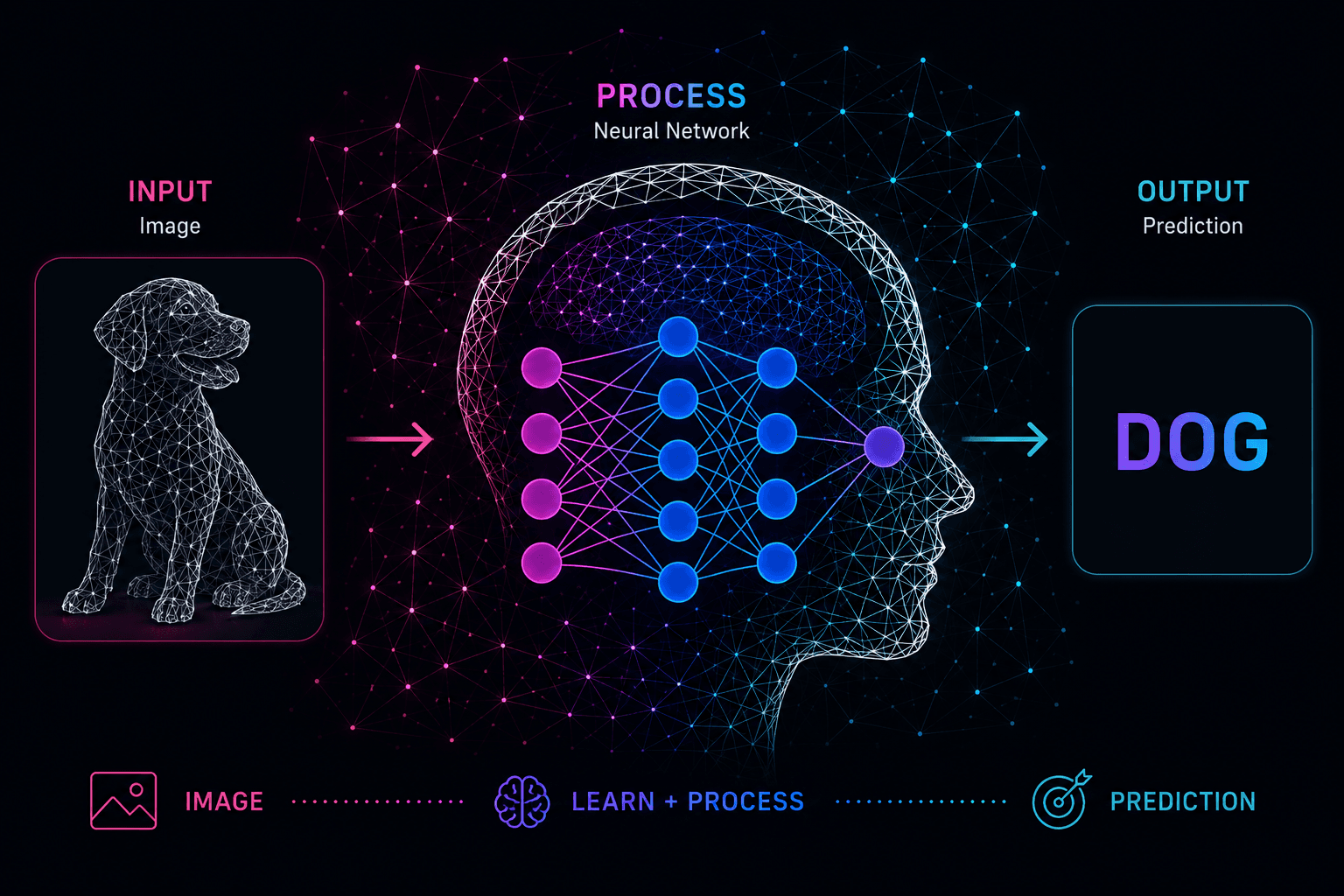
Deep neural networks process information layer by layer.
1. Input Layer
The input layer receives raw data such as:
Text
Images
Audio
Video
Numbers
2. Hidden Layers
The hidden layers identify patterns and relationships within the data.
Each layer extracts increasingly complex features.
Example:
Early layers detect edges
Middle layers detect shapes
Deep layers recognize full objects
This layered learning is what makes deep neural networks so powerful.
3. Output Layer
The output layer provides the final prediction or answer.
Examples:
“This is a cat.”
“This transaction may be fraud.”
“This sentence should be translated.”
Neural Networks and Deep Learning
People often confuse neural networks and deep learning, but they are closely connected.
Neural Networks
The overall AI structure is modeled after the human brain.
Deep Learning
The process of training large deep neural networks using massive datasets.
In simple terms:
Neural networks are the architecture
Deep learning is the advanced training approach
Common Applications of Deep Neural Networks
Deep neural networks are now used everywhere.
Natural Language Processing (NLP)
Language translation
Voice assistants
Computer Vision
Facial recognition
Medical imaging
Autonomous vehicles
Security systems
Recommendation Systems
Netflix recommendations
Amazon product suggestions
Spotify playlists
Fraud Detection
Banks use DNN machine learning systems to identify suspicious transactions.
Generative AI
Modern generative AI systems rely heavily on deep learning neural networks.
Advantages of Deep Neural Networks
High Accuracy and Better Prediction Performance
Deep Neural Networks (DNNs) often outperform traditional machine learning models when working with large and complex datasets.
They can identify subtle patterns, relationships, and trends that simpler algorithms may miss. This leads to higher prediction accuracy in areas like image recognition, speech recognition, fraud detection, medical diagnostics, and AI-powered search systems.
Automatic Feature Learning and Reduced Manual Work
One of the biggest advantages of deep neural networks is their ability to automatically learn features directly from raw data.
Traditional machine learning usually requires manual feature engineering, which can be time-consuming and dependent on human expertise. DNNs reduce this effort by learning important patterns automatically through multiple neural network layers.
Scalability With Large Data and Growing Systems
Deep learning models typically improve as more training data becomes available. This makes deep neural networks highly scalable for enterprise AI applications, big data environments, cloud computing platforms, and real-time analytics systems. Organizations handling massive datasets often benefit from the continuous performance improvements of DNN-based systems.
Complex Problem Solving Across Multiple Industries
Deep neural networks excel at solving highly complicated problems that involve unstructured or semi-structured data.
They are widely used in natural language processing (NLP), AI chatbots, autonomous vehicles, recommendation engines, facial recognition, healthcare AI, cybersecurity, and financial forecasting because they can process enormous amounts of information with impressive depth and precision.
Strong Performance With Unstructured Data
Unlike many traditional machine learning models, deep neural networks work extremely well with unstructured data such as images, videos, audio, text documents, and human language.
This ability powers modern technologies like voice assistants, generative AI, computer vision, and intelligent document processing systems.
Continuous Improvement Through Training
Deep learning systems can continuously improve over time through retraining and optimization.
As businesses collect new customer interactions, transactions, or operational data, DNN models can adapt and become smarter, more accurate, and more efficient in handling future predictions and decisions.
Real-Time AI Automation and Decision Making
Deep neural networks support advanced automation by enabling AI systems to make fast, data-driven decisions in real time.
This is especially valuable in industries like banking, healthcare, retail, logistics, and customer support, where speed and accuracy directly impact business performance and customer experience.
Foundation of Modern Artificial Intelligence
Deep neural networks are the foundation behind many of today’s most advanced AI technologies, including large language models (LLMs), generative AI tools, AI search engines, recommendation systems, and autonomous robotics.
Their ability to mimic certain aspects of human learning makes them one of the most powerful technologies driving the future of artificial intelligence.
Challenges of Deep Neural Networks
Large Computing Requirements and High Processing Power
Training deep neural networks requires enormous computational resources, including powerful GPUs, cloud computing infrastructure, and high-performance AI hardware. Deep learning models often consume significant memory, electricity, and processing time, especially when working with large-scale artificial intelligence applications and enterprise AI systems.
Massive Data Requirements for Better Accuracy
Deep neural networks perform best when trained on massive datasets. Unlike many traditional machine learning algorithms, deep learning models often require millions of data points to achieve high accuracy and reliable performance. Organizations without access to large, high-quality datasets may struggle to fully benefit from deep learning technology.
Black Box Problem and Limited Explainability
One of the biggest challenges of deep neural networks is the “black box” problem. It can be difficult to fully understand or explain how a deep learning model reached a specific prediction or decision. This lack of AI explainability creates concerns in industries like healthcare, banking, insurance, and government where transparency, compliance, and auditability are critical.
Long Training Times and Model Complexity
Deep learning systems can take hours, days, or even weeks to train depending on the model size and dataset complexity. Advanced neural network architectures with millions or billions of parameters increase development time, infrastructure costs, and operational complexity for AI engineering teams.
Risk of Overfitting and Poor Generalization
If a deep neural network is trained incorrectly or on biased datasets, it may overfit the training data instead of learning generalized patterns. This can reduce prediction accuracy when the model encounters new real-world scenarios, making proper model validation and testing extremely important.
Expensive Infrastructure and AI Development Costs
Building, training, and maintaining deep learning systems can be expensive. Companies often need specialized AI engineers, cloud GPU services, data pipelines, and ongoing model optimization. For smaller organizations, the cost of implementing deep neural networks may be significantly higher than traditional machine learning solutions.
Data Quality and Bias Concerns
Deep neural networks are heavily dependent on the quality of the training data. Poor, incomplete, or biased datasets can produce inaccurate or unfair AI outcomes. Bias in AI models has become a major concern in facial recognition, hiring systems, lending decisions, and automated recommendation engines.
Energy Consumption and Sustainability Challenges
Large deep learning models require significant energy consumption during training and deployment. As artificial intelligence adoption grows, concerns around environmental impact, sustainability, and efficient AI computing continue to increase across the technology industry.
Deep Neural Networks vs Traditional Machine Learning:
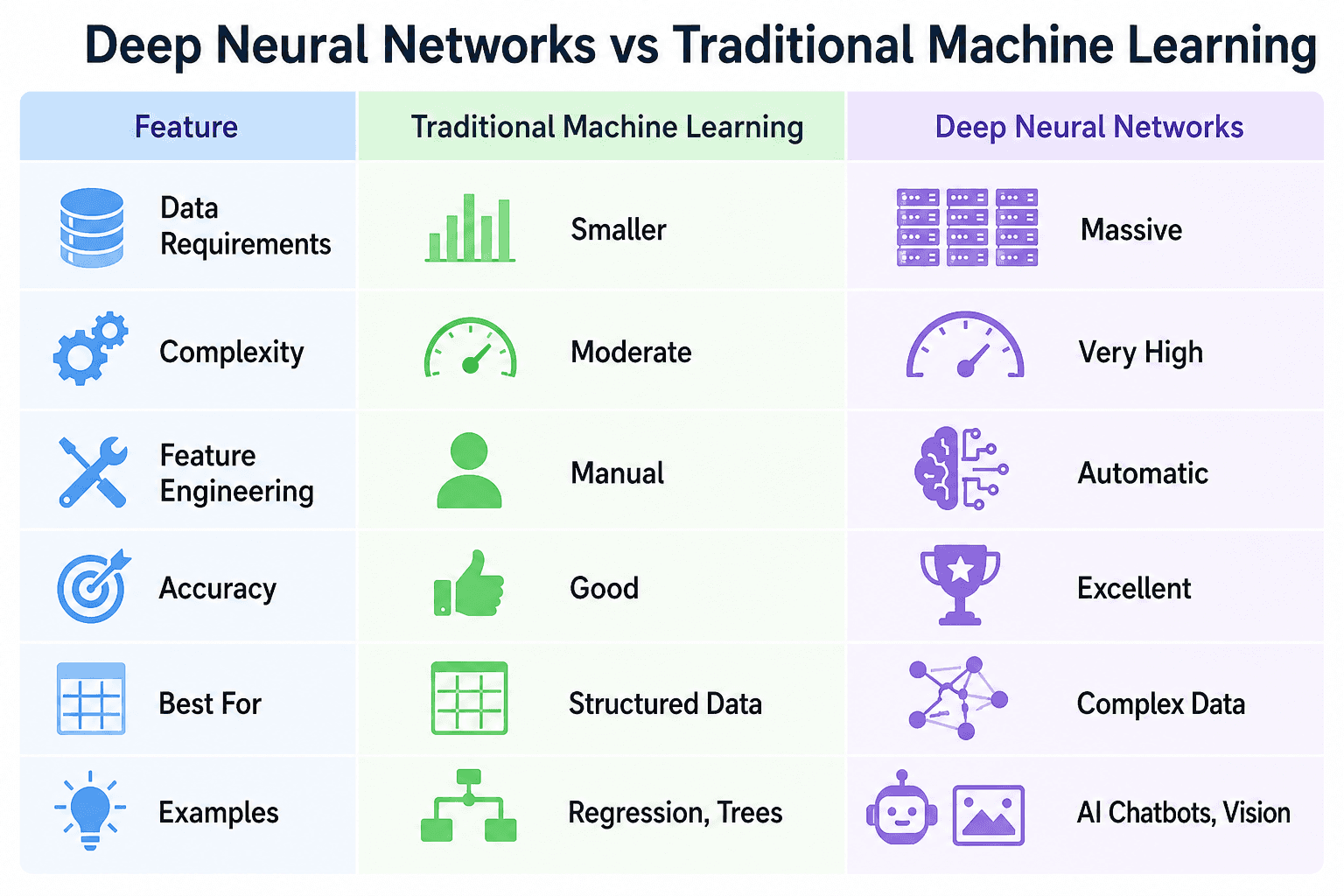
Traditional Machine Learning and Deep Neural Networks are both core areas of artificial intelligence, but they work differently.
Traditional machine learning is ideal for structured data and smaller datasets, while deep neural networks excel at handling massive, complex data for advanced AI applications like chatbots, computer vision, and speech recognition.
The image below highlights the key differences between the two approaches.
The Future of Deep Neural Networks
Deep neural networks continue evolving rapidly.
Future innovations may include:
Faster AI systems
Lower computing costs
More explainable AI
Better reasoning models
More human-like AI interactions
As artificial intelligence advances, deep neural networks will remain one of the core technologies shaping the future.
Frequently Asked Questions (FAQ)
What is a deep neural network?
A deep neural network is an AI model with multiple hidden layers designed to learn patterns from large amounts of data.
What does DNN mean?
DNN stands for Deep Neural Network.
What is the difference between neural networks and deep learning?
Neural networks are the AI structure, while deep learning refers to training deep multi-layer neural networks with large datasets.
Who invented deep neural networks?
Deep neural networks evolved over decades through contributions from researchers like:
Warren McCulloch
Walter Pitts
Frank Rosenblatt
Geoffrey Hinton
What are deep neural networks used for?
They are used for:
AI chatbots
Speech recognition
Computer vision
Fraud detection
Recommendation systems
Generative AI
Why are deep neural networks important?
They enable AI systems to solve highly complex tasks with remarkable accuracy.
What is DNN machine learning?
DNN machine learning refers to machine learning systems powered by deep neural networks and deep learning techniques.
Final Thoughts
The rise of deep neural networks completely transformed artificial intelligence.
When people search for:
deep neural network
what is a deep neural network
deep learning neural networks
what is dnn
dnn meaning
dnn machine learning
neural networks and deep learning
…they are exploring one of the most important technologies behind modern AI.
From simple perceptrons in the 1950s to today’s powerful generative AI systems, deep neural networks have reshaped how machines learn, think, and interact with the world.
Turn AI Knowledge Into Real Business Advantage
If your organization is exploring AI-powered search, intelligent automation, or enterprise knowledge systems, AskBobAI helps teams find trusted answers faster across their organization using advanced AI and connected business data.