Common Levels of Management in Organizations
Common Levels of Management in Organizations (And Why They Matter More Than You Think)
Why do some companies execute flawlessly while others constantly struggle?
Why do decisions get stuck in meetings instead of moving forward?
Do you actually understand how management levels impact performance?
The truth is simple:
How your management hierarchy is structured directly impacts speed, clarity, and results.
In this guide, we’ll break down:
The levels of management
How the management hierarchy works
The responsibilities at each level
Common breakdowns
And how AI platforms like AskBobAI are transforming how organizations operate
What Are the Levels of Management?
Levels of management refer to the structured hierarchy within an organization that defines authority, responsibility, and decision-making flow.
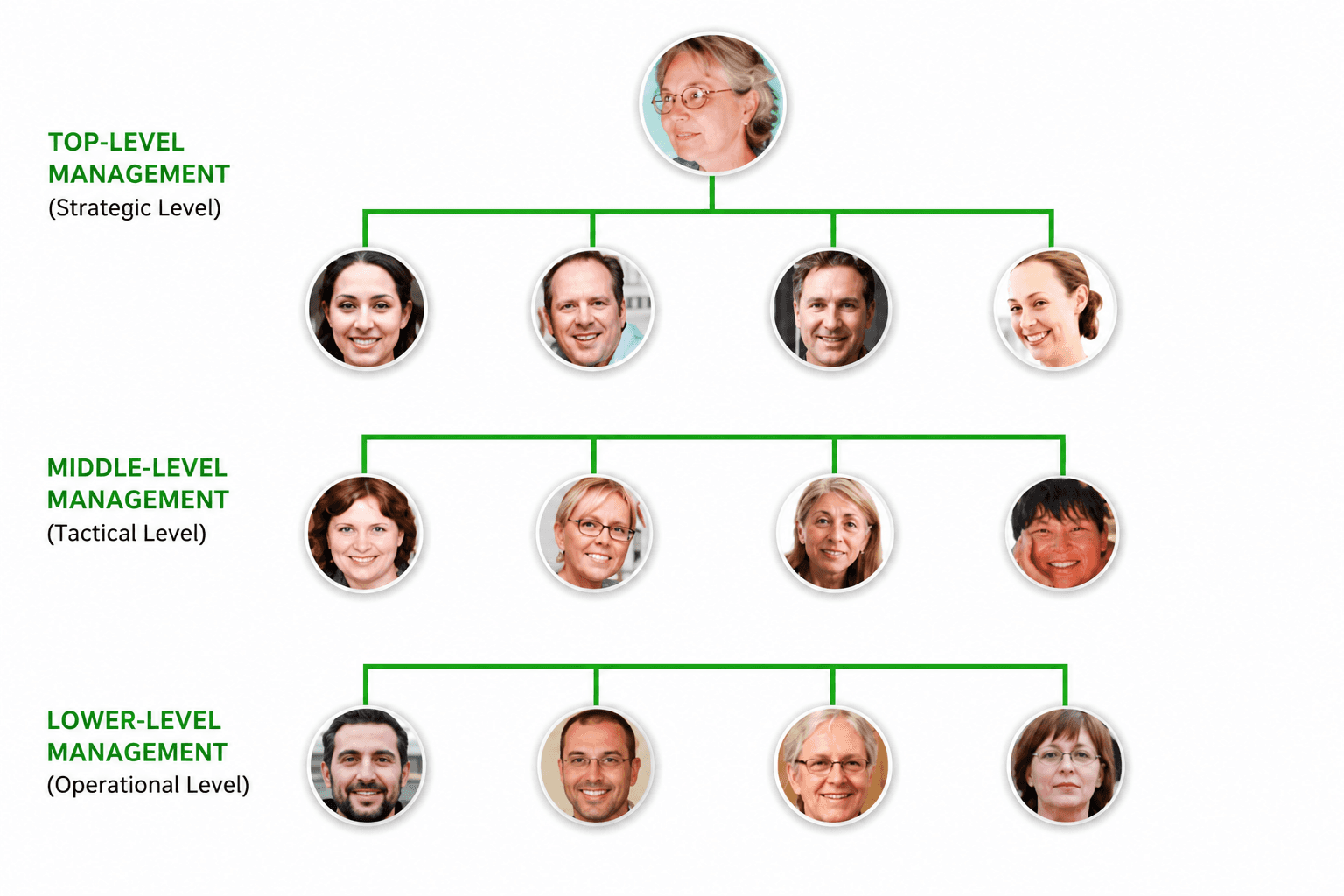
Most companies operate with three levels of management:
Top-Level Management
Middle-Level Management
Lower-Level (Operational) Management
This structure creates clarity across the organization and ensures decisions flow efficiently.
Why the Management Hierarchy Matters
A well-defined management hierarchy ensures:
Clear accountability
Faster decision-making
Better communication
Stronger execution
Without it:
Teams become misaligned
Decisions stall
Responsibility becomes unclear
The best companies don’t just have managers—they have a structured system of leadership.
The Three Levels of Management Explained
Every successful organization relies on a structured management system to operate effectively. The three levels of management help businesses organize leadership responsibilities, improve communication, and ensure company goals are achieved. From high-level strategy to daily execution, each layer of management serves a different purpose within the organization.
Why the Levels of Management Matter
Understanding the levels of management is important because businesses cannot scale efficiently without a clear leadership structure. Top-level leaders focus on long-term direction, middle managers connect strategy to execution, and lower-level managers oversee day-to-day operations. When these levels work together properly, organizations become more productive, aligned, and capable of growth.
How Management Hierarchies Improve Organizations
A strong management hierarchy creates accountability and clarity across departments. It helps companies make better decisions, improve employee performance, and maintain operational consistency. Without clearly defined management roles, organizations often experience communication breakdowns, slow execution, and confusion around responsibilities.
Let’s break down the 3 levels of management in a practical, real-world way.
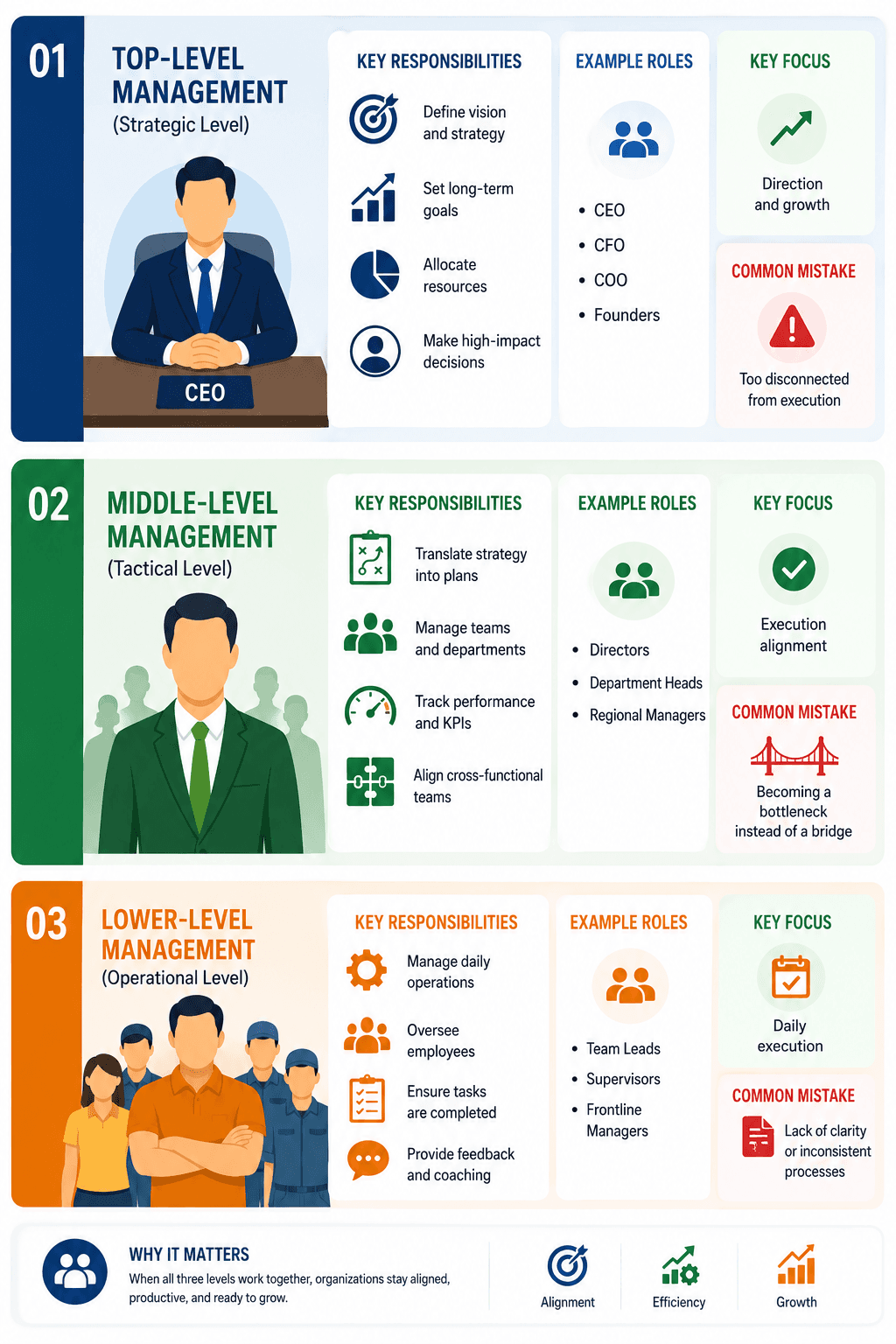
1. Top-Level Management (Strategic Level)
This is the highest level in the levels of management hierarchy.
Examples:
CEO
CFO
COO
Founders
Responsibilities:
Define vision and strategy
Set long-term goals
Allocate resources
Make high-impact decisions
Key focus: Direction and growth
Common mistake:
Too disconnected from execution
2. Middle-Level Management (Tactical Level)
Middle managers bridge strategy and execution.
Examples:
Directors
Department heads
Regional managers
Responsibilities:
Translate strategy into plans
Manage teams and departments
Track performance and KPIs
Align cross-functional teams
Key focus: Execution alignment
Common mistake:
Becoming a bottleneck instead of a bridge
3. Lower-Level Management (Operational Level)
This is where execution actually happens.
Examples:
Team leads
Supervisors
Frontline managers
Responsibilities:
Manage daily operations
Oversee employees
Ensure tasks are completed
Provide feedback and coaching
Key focus: Daily execution
Common mistake:
Lack of clarity or inconsistent processes
Visualizing the Levels of Hierarchy
Think of the levels of hierarchy like a pyramid:
Top → Strategy
Middle → Coordination
Bottom → Execution
Each level depends on the others.
If one breaks:
→ The entire system slows down
Different Levels of Management in Modern Organizations
While the traditional three levels of management still apply, modern companies often evolve:
Flat Organizations
Fewer management layers
Faster decisions
Higher autonomy
Matrix Organizations
Employees report to multiple managers
Cross-functional collaboration
Hybrid Structures
Combine hierarchy with flexibility
But even in modern setups:
The core management levels still exist—they’re just less visible.
Common Problems in Management Hierarchy
Most companies don’t fail because of bad strategy—they fail because of poor execution between levels.
1. Misalignment Between Levels
Top says one thing → Middle interprets differently → Bottom executes incorrectly
2. Information Silos
Teams operate with different data
3. Slow Decision-Making
Too many approvals → delays
4. Inconsistent Communication
Different answers across departments
How High-Performing Companies Fix This
They focus on:
Clear roles and responsibilities
Strong communication systems
Aligned KPIs across levels
Standardized knowledge
And increasingly…
They use AI.
How AI Is Transforming Management Levels
This is where AskBobAI plays a critical role.
Most breakdowns in management hierarchy come from:
Miscommunication
Lack of access to information
Inconsistent decision-making
With AI-powered knowledge systems:
Top management ensures strategy is documented
Middle management accesses consistent guidance
Lower management executes with clarity
Example:
Instead of asking multiple managers for answers…
→ Employees ask AskBobAI and get instant, source-backed responses
This removes:
Guesswork
Delays
Conflicting instructions
Real-World Example
Scenario:
A company rolls out a new policy.
Without structure:
Top defines it
Middle interprets it differently
Lower executes inconsistently
Result:
Confusion
Errors
Frustration
With AI support:
Policy is centralized in AskBobAI
Everyone accesses the same answer
Execution becomes consistent
Result:
Faster rollout
Better alignment
Less conflict
Key Skills Required at Each Management Level
Every level of management requires a different set of skills to keep an organization aligned and operating effectively.
While top-level leaders focus on strategy and long-term direction, middle managers drive coordination and execution across teams, and lower-level managers ensure daily operations run smoothly.
When each level develops the right leadership skills, communication improves, decisions become faster, and the entire organization performs at a higher level.
Each level of management requires a different set of leadership skills to keep the organization aligned, productive, and moving forward.
Top-Level
Strategic thinking
Vision setting
Decision-making
Middle-Level
Communication
Coordination
Performance management
Lower-Level
Execution
Coaching
Problem-solving
The stronger these skills, the stronger the organization.
Final Thoughts
The levels of management are not just a structure—they are a system.
When they work:
Strategy flows clearly
Teams execute effectively
Results scale
When they don’t:
Everything slows down
The companies that win are the ones that:
Align all levels
Remove friction
Enable faster decisions
If your organization is struggling with:
Misalignment across teams
Slow decision-making
Inconsistent execution
It’s not just a people problem—it’s a system problem.
See how AskBobAI helps align every level of management with instant, consistent, source-backed answers.
Book a demo today.
Frequently Asked Questions (Q&A)
What are the three levels of management?
The three levels are:
Top-level management
Middle-level management
Lower-level (operational) management
Why are levels of management important?
They create structure, improve communication, and ensure efficient decision-making across an organization.
What is a management hierarchy?
A management hierarchy is the structured arrangement of authority and responsibility within an organization.
What is the difference between management levels?
Each level focuses on different responsibilities:
Top → Strategy
Middle → Coordination
Bottom → Execution
Can organizations operate without management levels?
Some companies use flatter structures, but most still rely on some form of hierarchy to function effectively.
How does AI help management?
AI platforms like AskBobAI provide instant access to accurate information, improving alignment and reducing miscommunication across all levels.
What is the biggest challenge in the management hierarchy?
Misalignment between levels, leading to inconsistent execution and slow decision-making.