Interpersonal Skills Training Programs

Why do some employees thrive in teams while others struggle?
Why do miscommunications cost companies time, money, and trust?
Are your people technically strong—but weak in human interaction?
Here’s the reality:
Your company doesn’t scale on technical skills alone—it scales on interpersonal skills.
In this guide, we’ll break down:
What interpersonal skills really mean
Why they matter in the workplace
The best interpersonal skills training programs
How to improve and develop them
And how platforms like AskBobAI help reinforce them daily
What Does Interpersonal Skills Mean?
Let’s start with a clear definition.
Interpersonal skills are the abilities that allow people to communicate, interact, and work effectively with others.
They include:
Communication
Listening
Empathy
Conflict resolution
Collaboration
Also known as:
Human relations skills
Interpersonal communication skills
Simple truth:
You can have the best strategy in the world—but without strong interpersonal skills, execution breaks.
Why Interpersonal Skills in the Workplace Matter
If you have ever wondered why some teams succeed while others struggle, the answer is often interpersonal skills in the workplace. Strong communication, teamwork, emotional intelligence, and relationship-building help employees work better together and solve problems faster.
In today’s workplace, technical skills alone are not enough. Businesses with strong interpersonal skills often have happier employees, better teamwork, and stronger customer experiences.
Strong interpersonal skills in the workplace drive:
Better teamwork
Faster decision-making
Higher employee satisfaction
Improved customer experience
Without them:
Miscommunication increases
Conflicts escalate
Productivity drops
Most business problems are not technical—they are people problems.
What Are Interpersonal Skills Training Programs?
Interpersonal skills training programs are structured learning initiatives designed to improve how employees interact, communicate, and collaborate.
They focus on:
Communication techniques
Emotional intelligence
Conflict resolution
Leadership presence
Team dynamics
These programs are often part of broader corporate training offered by organizations like the American Management Association.
Core Interpersonal Communication Skills You Must Develop
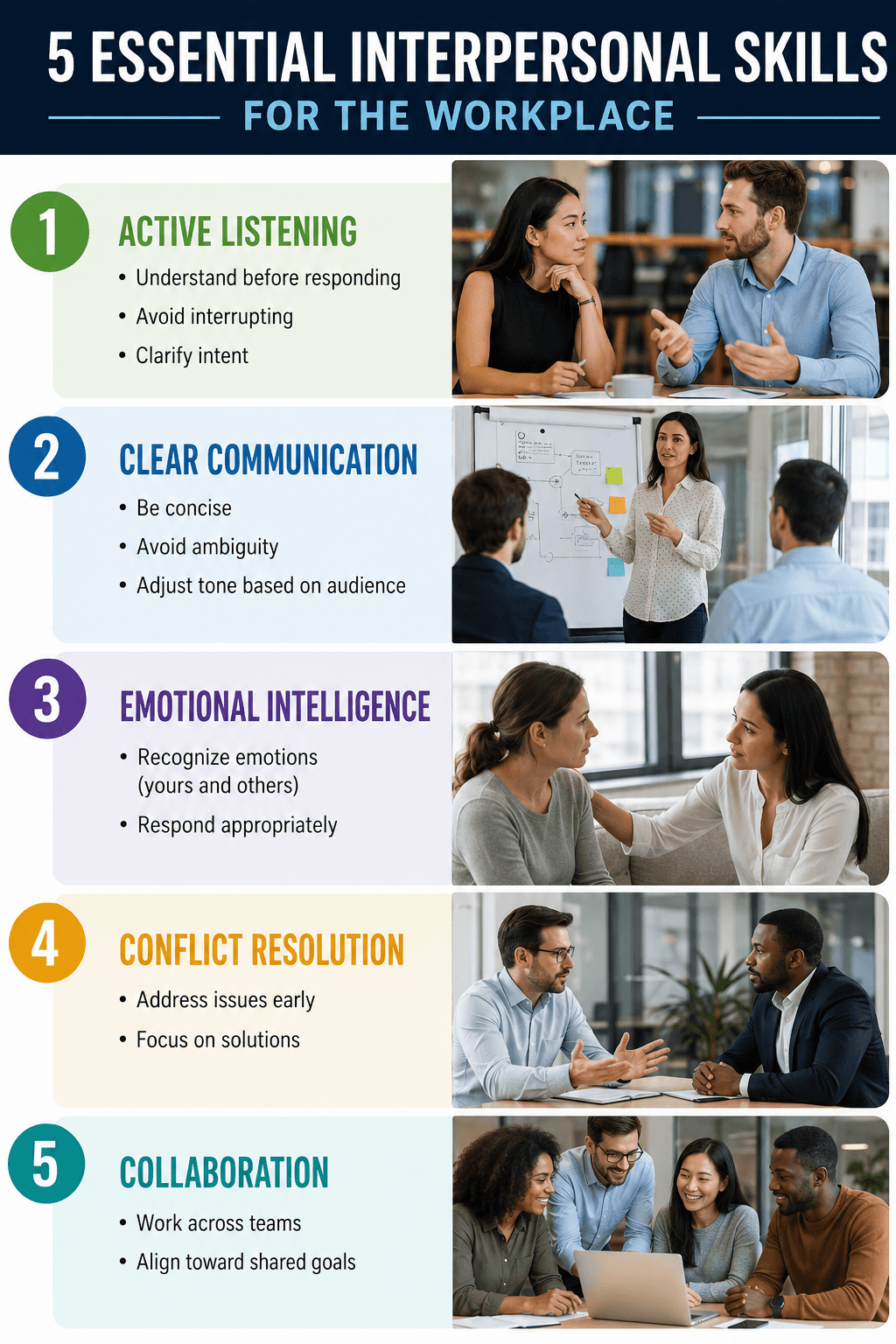
To succeed in today’s workplace, employees must master:
1. Active Listening
Understand before responding
Avoid interrupting
Clarify intent
2. Clear Communication
Be concise
Avoid ambiguity
Adjust tone based on audience
3. Emotional Intelligence
Recognize emotions (yours and others)
Respond appropriately
4. Conflict Resolution
Address issues early
Focus on solutions
5. Collaboration
Work across teams
Align toward shared goals
These are the foundation of all interpersonal training programs.
How to Improve Interpersonal Skills
Here’s what actually works in real life—not just in theory.
1. Practice Real Conversations
You don’t improve communication by reading about it. You improve by talking to people regularly.
Real-life example:
Instead of sending another Slack message when there’s confusion at work, walk over or jump on a quick call. A 5-minute conversation often solves what 20 back-and-forth messages cannot.
2. Ask for Feedback
Most people don’t realize how they come across until someone tells them.
Real-life example:
After leading a meeting or presentation, ask a coworker: “Was I clear, or did anything feel confusing?” You may discover you interrupt people, over-explain, or rush conversations without realizing it.
3. Observe High Performers
Strong communicators leave clues everywhere.
Real-life example: Watch how a respected manager handles difficult conversations. Notice how they stay calm, listen first, and explain things clearly instead of reacting emotionally.
4. Take Structured Training
Some skills improve faster when you have a framework and practice.
Real-life example: A manager struggling with team conflict takes a communication or leadership workshop and learns simple techniques like active listening, de-escalation, and giving feedback without sounding aggressive.
5. Reflect and Adjust
The best communicators constantly self-correct.
Real-life example: After a tough meeting, take 2 minutes to think:
Did I really listen?
Did I explain myself clearly?
Did I make the situation better or worse?
Small adjustments over time create major improvements in interpersonal skills.
How to Develop Interpersonal Skills at Scale
For organizations, the challenge is not just individual improvement—it’s consistent improvement across teams.
To develop interpersonal skills effectively:
Standardize training programs
Reinforce behaviors daily
Align communication frameworks
This is where most companies fail: They train once—but don’t reinforce.
The Problem With Traditional Interpersonal Training
Even the best interpersonal skills training programs face challenges:
Employees forget what they learned
No reinforcement in daily work
Inconsistent communication across teams
Skills degrade over time
Training without reinforcement = wasted investment
How AI Reinforces Interpersonal Skills Daily
This is where AskBobAI becomes a force multiplier.
Instead of relying only on training sessions:
With AI-powered systems:
Employees get real-time guidance
Communication becomes consistent
Policies and tone are standardized
Teams align faster
Example:
An employee drafts a response to a customer…
Instead of guessing tone or wording → AskBobAI provides a clear, professional response with guidance.
This turns interpersonal skills from theory into daily practice.
Real-World Example
Scenario:
A support team struggles with inconsistent communication.
Without training:
Different responses from different agents
Customers get confused
Internal friction increases
With training + AI:
Employees learn communication frameworks
AskBobAI reinforces tone and messaging
Responses become consistent
Result:
Better customer experience
Faster resolution times
Stronger team alignment
Benefits of Strong Interpersonal Skills
When organizations invest in developing interpersonal skills, they see:
Improved collaboration
Reduced conflict
Faster execution
Higher employee engagement
Better leadership outcomes
These are not “soft skills”—they are business-critical skills.
Final Thoughts
Interpersonal skills are no longer optional.
They are:
The foundation of leadership
The driver of teamwork
The key to execution
The companies that win will:
Train their people
Reinforce daily behaviors
Use AI to scale consistency
Frequently Asked Questions (Q&A)
What are interpersonal skills?
Interpersonal skills are the abilities used to communicate, interact, and work effectively with others.
What does interpersonal skills mean in the workplace?
It refers to how employees communicate, collaborate, and build relationships with coworkers, customers, and stakeholders.
How can I improve my interpersonal communication skills?
Practice active listening, seek feedback, observe strong communicators, and participate in structured training programs.
What are interpersonal skills training programs?
They are programs designed to improve communication, emotional intelligence, collaboration, and conflict resolution.
Why are interpersonal skills important?
They improve teamwork, reduce conflict, and enhance overall business performance.
How do you develop interpersonal skills in an organization?
Through training, reinforcement, feedback, and consistent communication frameworks supported by tools like AskBobAI.
What are examples of interpersonal skills?
Examples include communication, empathy, listening, teamwork, and conflict resolution.
If your organization struggles with:
Miscommunication
Inconsistent messaging
Team friction
It’s time to go beyond training.
See how AskBobAI helps teams apply interpersonal skills in real time—right where work happens.
Image Credit:SIphotography