What Is RAG in AI?
Who is searching for the word RAG—and why has a once niche AI term suddenly become one of the most important concepts in business technology?
A year ago, many people outside of AI research had never heard the term. Today, executives, IT leaders, product teams, and fast-growing companies are actively trying to understand it. Why? Because as AI adoption accelerates, organizations are learning a hard truth: a smart-sounding answer is not always a correct answer.
That challenge became impossible to ignore after the rise of modern generative AI tools led by companies like OpenAI. Millions of people saw firsthand how powerful large language models could be—but businesses also saw the risk when AI confidently gave incomplete, outdated, or incorrect information. In enterprise environments, that can mean wasted time, poor decisions, compliance issues, or lost trust.
That is where RAG in AI comes in.
RAG stands for Retrieval-Augmented Generation. It has quickly become one of the most important advancements in enterprise AI because it combines the reasoning power of language models with real data sources such as documents, policies, websites, databases, PDFs, and internal knowledge bases.
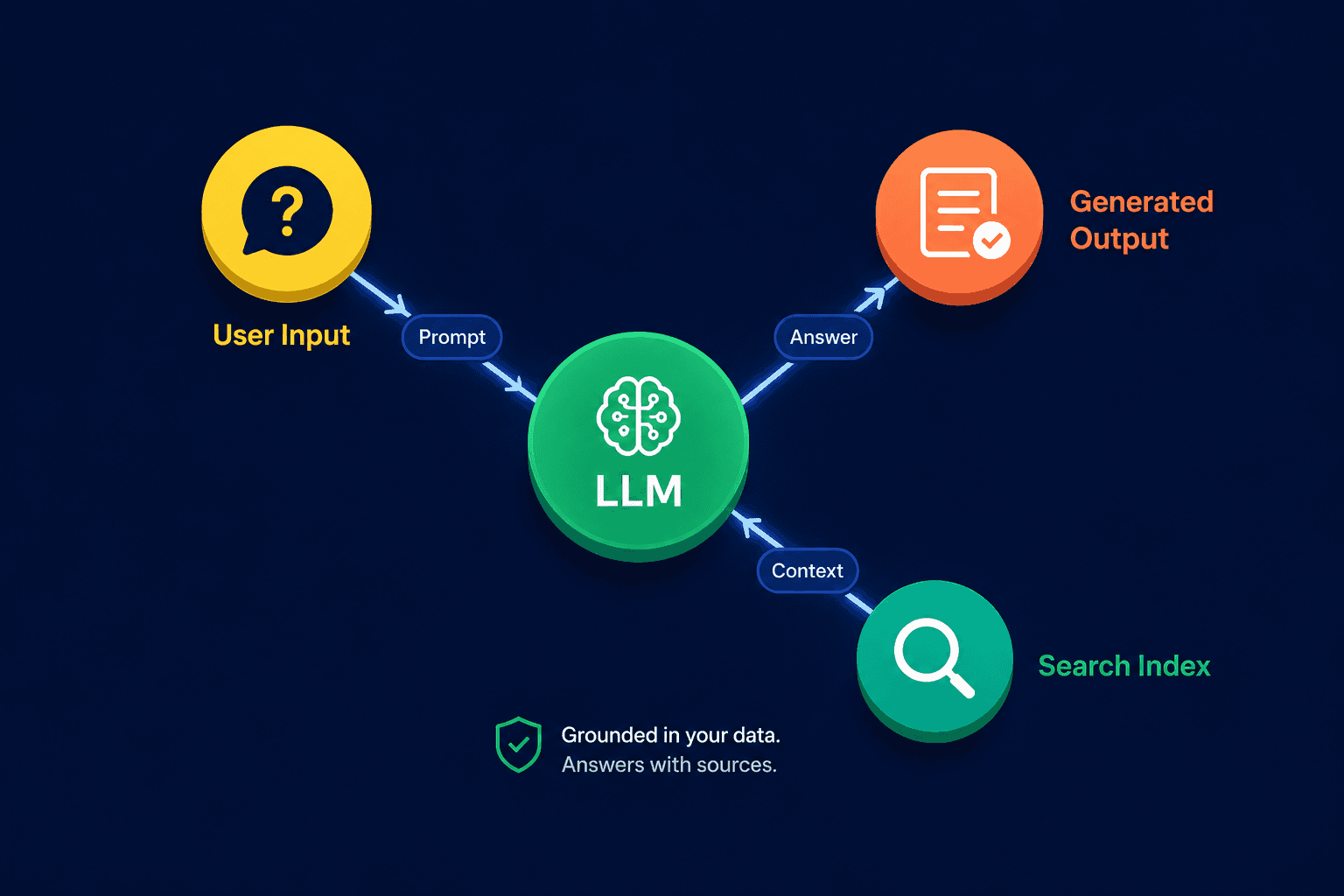
Instead of guessing, RAG helps AI retrieve the right information first—then generate an answer based on that information.
In simple terms, RAG helps transform AI from something impressive to something dependable.
This guide explains what RAG is, how it works, why it matters, common use cases, benefits, challenges, and how businesses are using it to gain a competitive edge.
What Does RAG Mean in AI?
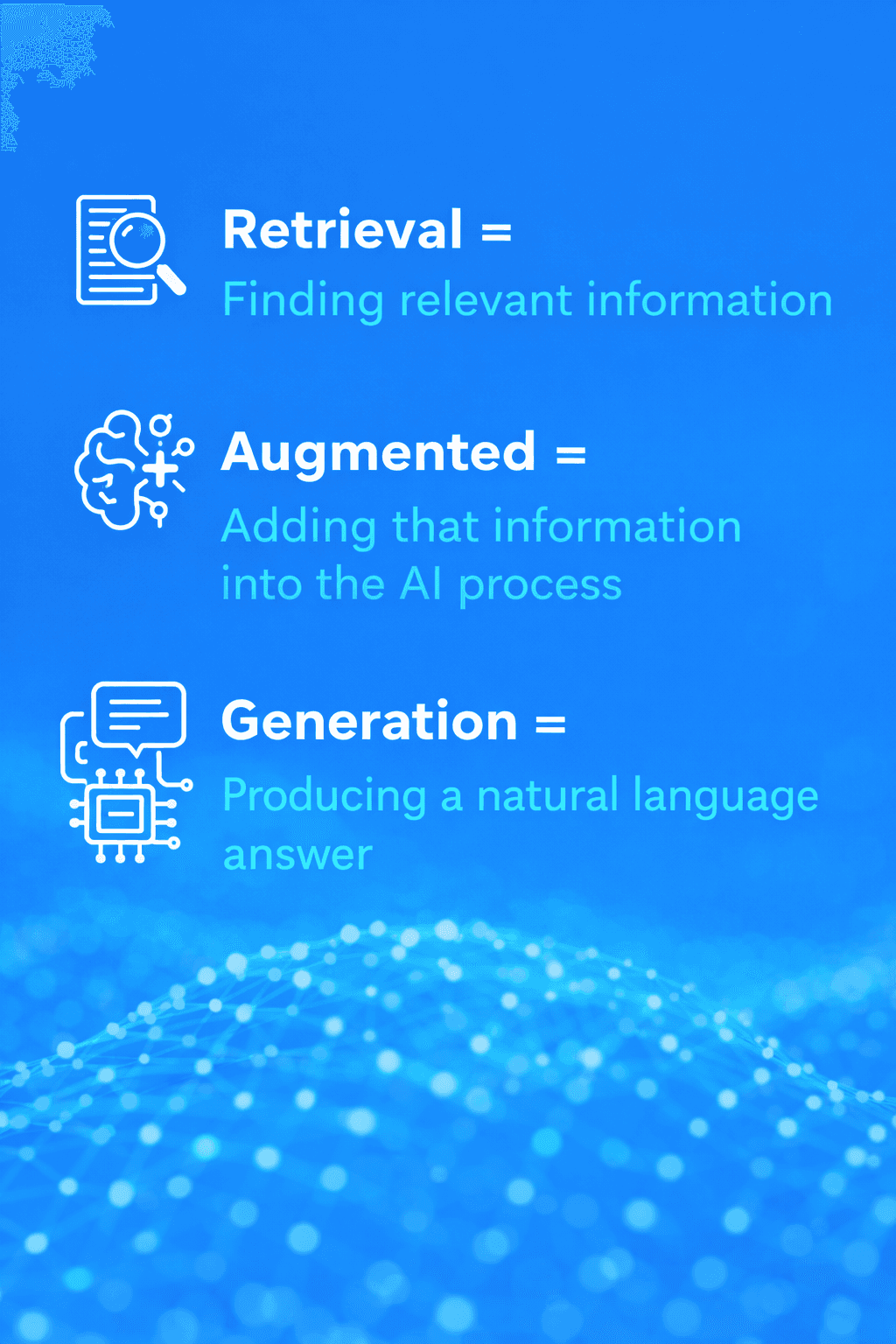
RAG stands for:
Retrieval = Finding relevant information
Augmented = Adding that information into the AI process
Generation = Producing a natural language answer
Traditional AI models rely mainly on what they learned during training. RAG changes that model by allowing AI to search external knowledge sources in real time.
That means the answer can be based on:
Your company handbook
Product manuals
Compliance policies
Customer records
Internal procedures
Research reports
Website content
Knowledge bases
Support tickets
Instead of only using memory, the AI can use facts.
Why RAG Matters
Many organizations want AI, but wanting AI and successfully using AI are two very different things.
The excitement around generative AI has made one thing clear: people love speed, convenience, and the ability to ask questions in natural language. But inside real businesses, those benefits alone are not enough. Leaders also need confidence that the answers are accurate, relevant, secure, and grounded in trusted information.
That is where many basic AI deployments fall short. A general model may be impressive, but it does not automatically understand your company’s internal knowledge, latest policy updates, customer-specific rules, or proprietary workflows. It may generate a strong-sounding answer while missing the exact context your business depends on.
For companies operating in finance, healthcare, insurance, legal, government, or any process-driven industry, that gap matters.
Organizations need more than intelligence. They need dependable intelligence.
They need:
Accuracy
Explainability
Current information
Secure access controls
Trustworthy outputs
Reduced hallucinations
Without RAG, AI often struggles in business environments because general models may not know your company’s private data or latest policies.
With RAG, the AI can answer using your actual content—turning scattered knowledge into usable answers employees can trust.
That is why RAG has become one of the top enterprise AI strategies in 2026.
One of the reasons RAG has gained so much attention is because the concept is powerful, but the workflow is easy to understand. At a high level, RAG helps AI behave less like a guessing machine and more like a research assistant that can search, read, and respond in seconds.
Instead of relying only on what the model learned during training, RAG adds a live retrieval step before the answer is generated. That extra step can dramatically improve relevance, trust, and usefulness.
The RAG process usually follows five steps:
1. A User Asks a Question
Everything starts with a natural language question. The user does not need to know where the information lives or what file to open. They simply ask what they need.
Examples:
What is our PTO policy?
Which loan program allows a 580 credit score?
How do I reset my software access?
What did the customer order last quarter?
Example in action:
An employee types, “How many vacation days do new hires receive?” instead of searching through a handbook manually.
2. The System Searches for Relevant Data
Once the question is asked, the AI system searches connected sources to find the most relevant information.
This may include:
PDFs
Databases
Websites
Documents
Internal wikis
CRM systems
Helpdesk platforms
Instead of searching everything equally, strong RAG systems rank and retrieve the most relevant content first.
Example in action:
For the PTO question, the system finds the employee handbook, HR policy page, and onboarding guide.
3. Relevant Content Is Sent to the Model
After retrieval, the selected information is packaged into context and passed into the language model. This gives the model grounded material to work from before it writes a response.
Think of this as giving the AI an open-book reference before the test begins.
Example in action:
The AI receives the exact handbook section that states full-time employees receive 15 PTO days annually.
4. The AI Generates an Answer
Now the model generates a response using the retrieved content instead of relying only on memory or general internet knowledge.
This is where RAG becomes powerful: the answer sounds natural, but it is based on actual business data.
Example in action:
The AI responds: “New full-time hires receive 15 paid time off days per year, accrued monthly beginning on the first day of employment.”
5. Sources Can Be Shown
Many RAG systems also display citations, references, or source links so users can verify where the answer came from.
This is especially valuable in enterprise environments where trust and accountability matter.
Example in action:
Below the answer, the system shows: Source: Employee Handbook > Benefits Section > PTO Policy.
This builds trust, encourages adoption, and helps users validate important answers quickly.
Other Simple Examples of RAG
RAG becomes even easier to understand when you look at everyday business questions across different roles. In almost every department, people waste time searching for answers that already exist somewhere inside the company.
Imagine an employee asks:
What is our reimbursement limit for travel meals?
Without RAG:
The AI may guess based on common business practices or give a generic answer that sounds reasonable but may not match your actual company policy.
With RAG:
The AI retrieves your travel policy and answers:
“The reimbursement limit is $75 per day for domestic travel according to the Finance Travel Policy updated January 2026.”
That difference is massive.
Because in business, the right answer is not just about sounding smart—it is about being correct.
HR Example
Question: What is our parental leave policy?
Without RAG: The AI gives a general explanation of common leave policies.
With RAG: The AI retrieves your HR handbook and answers with your exact leave eligibility, duration, and process.
IT Example
Question: How do I request access to Salesforce?
Without RAG: The AI offers generic software access advice.
With RAG: The AI retrieves the internal IT request process, approval steps, and helpdesk link.
Sales Example
Question: Do we have a case study for credit unions?
Without RAG: The AI may invent examples or give broad suggestions.
With RAG: The AI retrieves your approved case study library and provides the most relevant customer story.
Customer Support Example
Question: How do I reset my device settings?
Without RAG: The AI gives a general troubleshooting response.
With RAG: The AI retrieves the exact support article for that product version.
Finance Example
Question: When do expense reports need to be submitted?
Without RAG: The AI guesses based on common monthly close practices.
With RAG: The AI cites the finance policy with the true submission deadline.
Executive Example
Question: What were our top customer complaints last quarter?
Without RAG: The AI cannot know unless previously trained on your data.
With RAG: The AI retrieves support trends, survey feedback, and ticket summaries to provide a grounded answer.
This is why RAG matters across every function. It turns existing company knowledge into fast, usable answers for the people who need them most.
Why Businesses Love RAG
1. Better Accuracy
RAG reduces wrong answers by grounding responses in real documents.
2. Uses Private Data
Your business knowledge becomes usable through AI.
3. Current Information
Unlike static model training, RAG can access recently updated documents.
4. Lower Risk
This is critical for regulated industries like finance, healthcare, insurance, and government.
5. Faster Productivity
Employees spend less time searching and more time executing.
RAG Use Cases by Department
Customer Support
RAG helps support teams instantly answer questions using:
Help center articles
Troubleshooting guides
Product documentation
Previous cases
Result: Faster resolution times and lower ticket volume.
Sales Teams
Sales reps can ask:
What pricing package fits this customer?
What case studies do we have for healthcare?
What objections have we solved before?
Result: Faster deals and better consistency.
HR Teams
Employees can ask:
What is maternity leave policy?
How do benefits enrollment deadlines work?
What is our remote work policy?
Result: Better employee self-service.
IT Teams
RAG can surface:
Password reset steps
Security procedures
Device setup instructions
Internal troubleshooting guides
Result: Reduced repetitive tickets.
Finance & Compliance
Teams can ask complex policy questions using approved internal documents.
Result: Better governance and faster decisions.
RAG in Highly Regulated Industries
RAG is especially powerful where wrong answers are expensive.
Examples:
Mortgage lending
Banking
Credit unions
Insurance
Healthcare
Legal operations
Public sector agencies
These industries need answers tied to trusted sources—not guesses.
RAG vs Fine-Tuning
Many people confuse RAG with fine-tuning.
RAG
Uses external knowledge sources during question time.
Best for:
Changing data
Internal documents
Large content libraries
Need for citations
Fine-Tuning
Retrains a model on examples or behavior patterns.
Best for:
Tone
Formatting
Specific workflows
Repeated output style
In many real systems, companies use both.
Challenges of RAG
RAG is powerful, but implementation matters.
Data Quality
Bad documents create bad answers.
Poor Retrieval
If the wrong content is retrieved, the answer may still fail.
Permissions
Users should only access data they are authorized to see.
Chunking & Indexing
Documents must be broken into searchable segments properly.
Ongoing Maintenance
Knowledge changes. Systems need updates.
RAG and Deep Learning: Intelligence Meets Real-Time Knowledge
Deep Learning and Retrieval-Augmented Generation (RAG) are foundational to modern AI systems, especially in enterprise environments where speed and accuracy matter. Deep learning powers the intelligence behind AI by training neural networks on large datasets to understand language, recognize patterns, and generate human-like responses. This is what enables AI to answer questions, automate workflows, and support decision-making across industries like finance, healthcare, and SaaS.
RAG builds on deep learning by connecting that intelligence to real-time data sources such as internal documents, knowledge bases, and systems of record. Instead of relying only on pre-trained knowledge, RAG retrieves the most relevant information before generating a response—making answers more accurate, contextual, and trustworthy. For platforms like AskBob, this combination delivers instant, source-backed answers that reduce manual searching, improve compliance, and help teams move faster with confidence.
What Makes a Great RAG System?
The best RAG platforms focus on more than chat.
Look for:
Strong retrieval accuracy
Secure integrations
Access controls
Fast response time
Citations and sources
Multi-source search
Admin controls
Analytics
Easy deployment
Scalability
The Future of RAG
RAG is evolving fast.
The next generation includes:
Multi-Step Agents
AI systems that retrieve, reason, act, and complete workflows.
Structured Data + Documents
Combining databases with unstructured content.
Personalized Answers
Responses based on role, department, or customer context.
Voice + Multimodal RAG
Ask questions through voice, images, or uploaded files.
Automated Workflows
AI does not just answer—it triggers actions.
Is RAG Only for Big Companies?
No.
Small and mid-sized businesses benefit too.
Even a company with:
SOP documents
Shared drives
HR policies
Product FAQs
Customer tickets
can unlock value with RAG.
Often the biggest pain is not lack of knowledge—it is inability to access it quickly.
Why RAG Is Growing So Fast
Businesses now realize:
The problem is not having data.
The problem is turning data into usable intelligence.
That is exactly what RAG solves.
It turns scattered knowledge into immediate answers.
Final Thoughts: What Is RAG in AI?
RAG is one of the most practical and valuable forms of AI today.
It helps organizations move from:
Searching → Answering
Guessing → Grounded responses
Slow decisions → Faster execution
Hidden knowledge → Accessible intelligence
If your company has information trapped in systems, folders, PDFs, policies, or databases, RAG may be the fastest path to real AI value.
FAQ About RAG
What is RAG in simple terms?
RAG is an AI that looks up real information before answering.
What does RAG stand for?
Retrieval-Augmented Generation.
Why is RAG important?
Because it improves accuracy and helps AI use current data.
Is RAG better than ChatGPT alone?
For company-specific knowledge, often yes.
Can RAG use private company data?
Yes, when implemented securely.
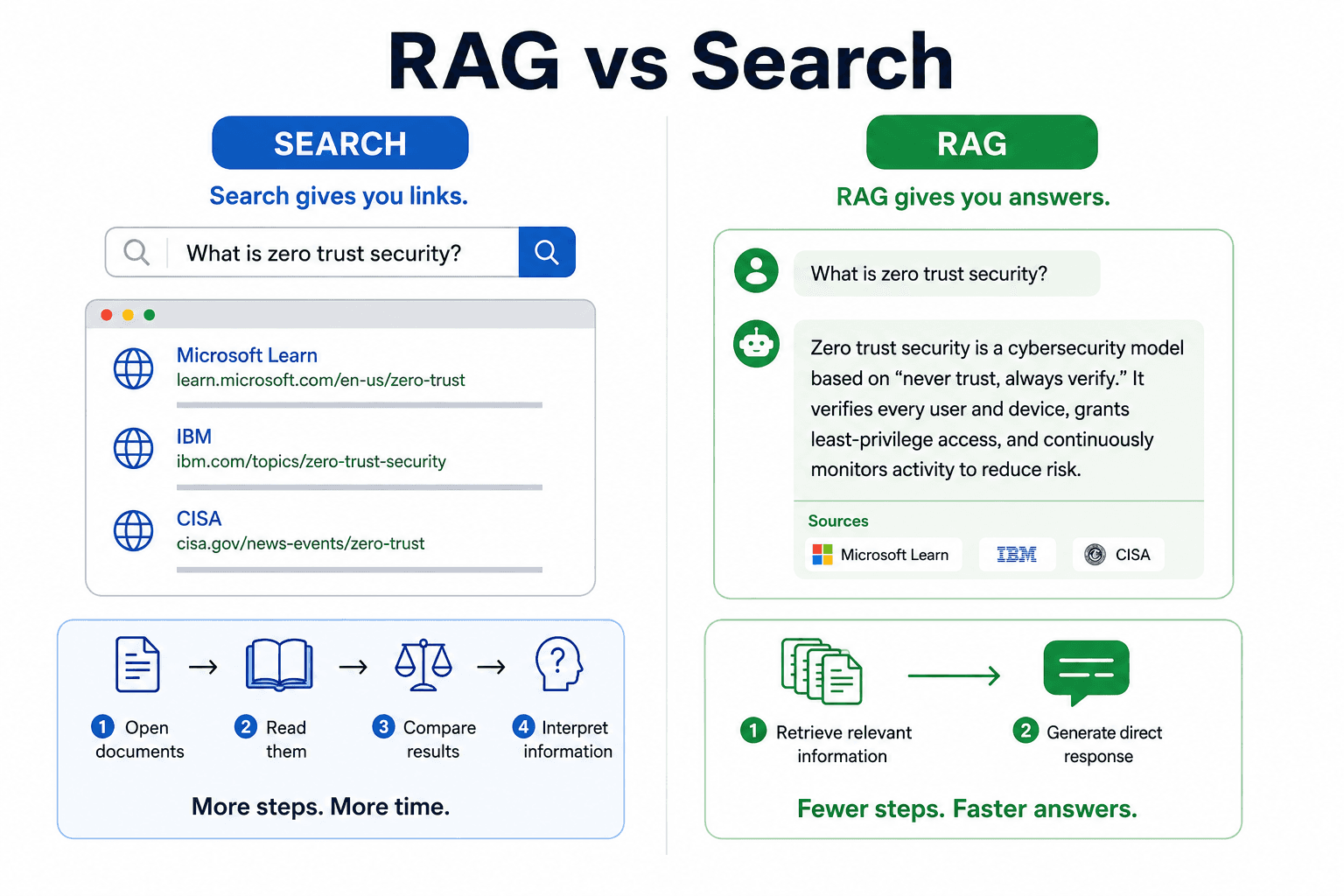
Does RAG replace search?
Not always. It enhances search by giving direct answers.