What Is Deep Learning?
How can a computer recognize faces, understand speech, drive cars, and generate human-like text?
The answer often involves deep learning. It is one of the most powerful technologies behind modern artificial intelligence and has transformed industries ranging from healthcare to finance to entertainment.
If you are searching for what is deep learning, here is the simple answer:
Deep learning is a branch of artificial intelligence that uses multi-layered neural networks to learn patterns from large amounts of data and make predictions or decisions.
Instead of being manually programmed for every rule, deep learning systems learn from examples.
Definitions: Deep Learning Meaning
Deep Learning Definition
The deep learning definition is a machine learning method that uses artificial neural networks with many layers to process data, recognize patterns, and improve performance over time.
Define Deep Learning
To define deep learning simply:
It is a way for machines to learn complex tasks by analyzing data through multiple computational layers.
Deep Learning Meaning
The deep learning meaning comes from the “deep” structure of the network, where many hidden layers help the system understand increasingly complex features.
What Is Deep Learning AI?
What is deep learning AI? It refers to artificial intelligence systems powered by deep learning models—neural networks with many layers—that can perform tasks such as image recognition, speech processing, recommendation engines, and language generation.
To understand how deep learning became so powerful, it helps to look at how it evolved over time.
Timeline of Deep Learning
1965 – First deep learning models introduced by Alexey Ivakhnenko and Valentin Lapa, creating multi-layer neural networks.
1967–1968 – Shun-Ichi Amari pioneers training deep networks using stochastic gradient descent.
1970 – Seppo Linnainmaa introduces backpropagation, enabling efficient training of neural networks.
1980s – Neural networks gain traction but remain relatively shallow due to computational limits.
1991–1993 – Jürgen Schmidhuber develops unsupervised pre-training, enabling much deeper networks.
2010s – GPUs and large datasets drive breakthroughs in deep learning performance and adoption.
Today – Deep learning powers modern AI, including computer vision, speech recognition, and generative AI systems.
How Does Deep Learning Work?
Many people ask, how does deep learning work?
A deep learning model—part of Artificial Intelligence—uses layers of artificial neurons (inspired by the human brain) to process data and learn patterns over time. These models are built using techniques from Machine Learning, but go deeper (literally) with multiple layers that refine understanding step-by-step.
Visualizing Deep Learning Layers
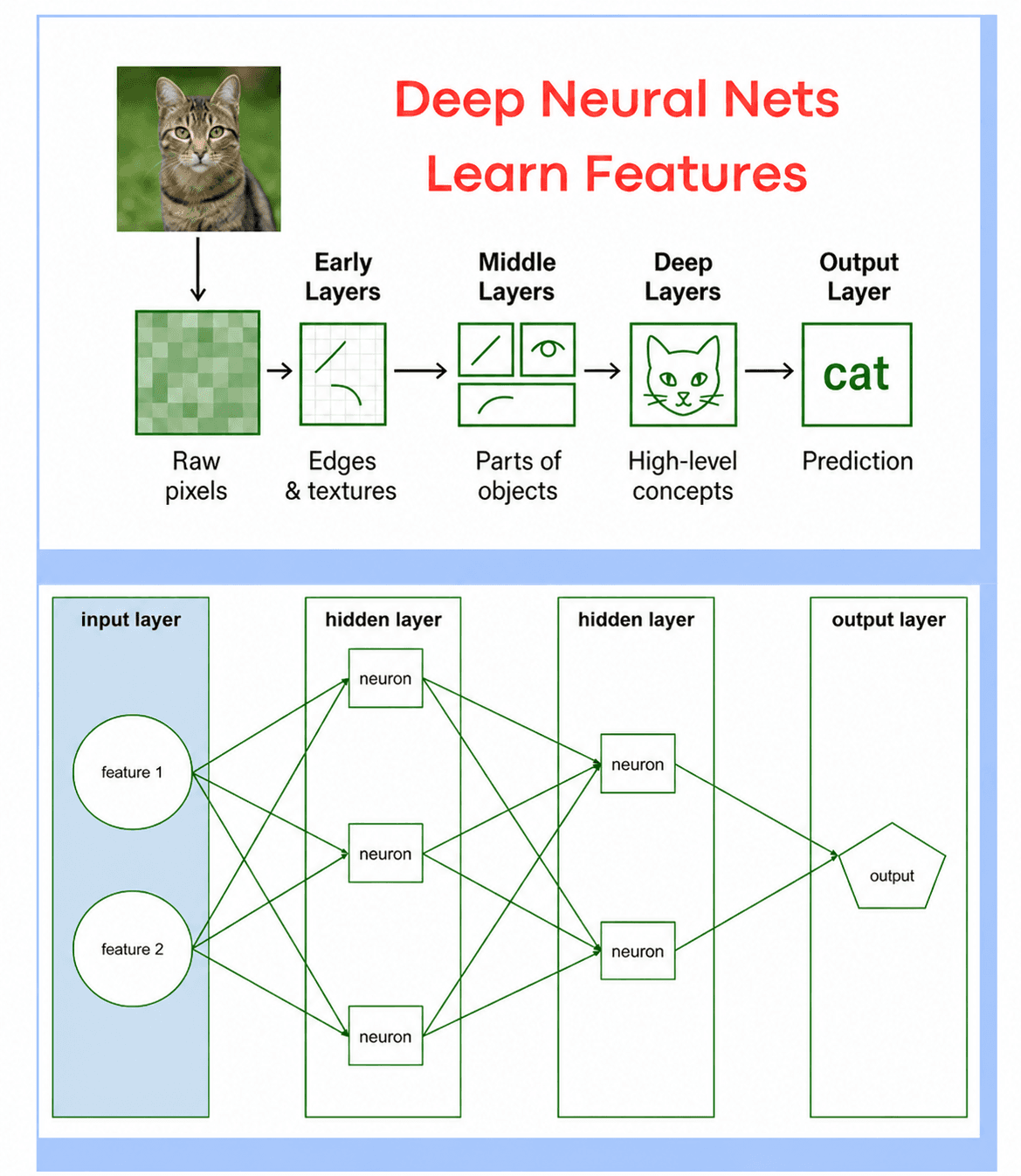
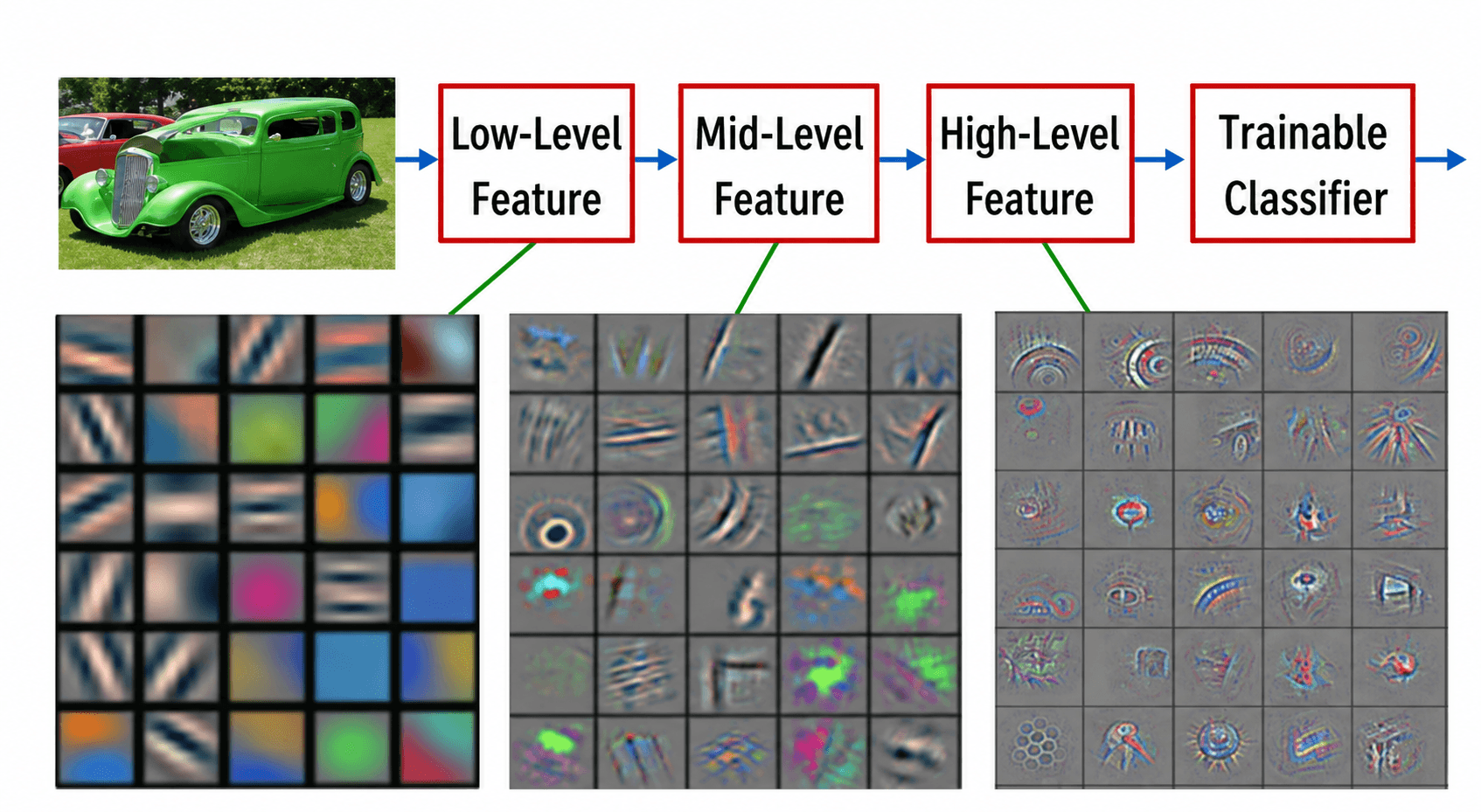
Each layer transforms raw input into more meaningful representations:
Example: Image Recognition
Input Layer: Receives raw pixel data from an image
Hidden Layer 1: Detects basic features like edges and lines
Hidden Layer 2: Combines edges into shapes
Hidden Layer 3: Identifies objects (faces, animals, etc.)
Output Layer: Produces a prediction like “cat,” “dog,” or another label
This layered approach is what allows deep learning models to handle complex tasks like facial recognition, speech processing, and natural language understanding.
The Core Mathematical Concept
At its core, each neuron performs a simple calculation:
y=f(Wx+b)y = f(Wx + b)y=f(Wx+b)
Where:
x = input data
W = weights (what the model learns)
b = bias (adjustment factor)
f = activation function (adds non-linearity)
y = output
During training, the model continuously adjusts its weights and biases using large datasets and optimization techniques (like gradient descent). Over time, it minimizes errors and improves prediction accuracy.
Examples of Deep Learning
Examples make deep learning easier to understand.
Example 1: Face Recognition
Phones can identify faces and unlock devices securely.
Examples include systems used by Apple and Samsung devices.
Example 2: Voice Assistants
Virtual assistants understand spoken commands and respond naturally.
Examples include Siri, Google Assistant, and Alexa.
Example 3: Recommendation Engines
Streaming and shopping platforms recommend content you are likely to enjoy.
Examples include Netflix, Amazon, and YouTube.
Example 4: Medical Imaging
Hospitals use deep learning to detect patterns in scans.
Example 5: Self-Driving Cars
Vehicles analyze roads, traffic signs, and obstacles in real time.
Examples include Tesla and Waymo.
Common Types of Deep Learning Models
Neural Networks
Basic deep learning architecture inspired by the brain.
Convolutional Neural Networks (CNNs)
Used for image recognition and computer vision.
Recurrent Neural Networks (RNNs)
Used for sequences such as speech and text.
Transformers
Used in modern language models and generative AI.
Autoencoders
Used for anomaly detection and data compression.
Use Cases for Deep Learning
Organizations use deep learning AI in many industries.
Healthcare
Detect disease, analyze scans, and predict patient outcomes.
Finance
Spot fraud, score risk, and automate decisions.
Retail
Personalize recommendations and forecast demand.
Manufacturing
Predict equipment failures and inspect quality.
Cybersecurity
Detects threats and suspicious behavior.
Marketing
Optimize ads, segmentation, and customer targeting.
Customer Support
Power chatbots, summarization, and smart routing.
Benefits of Deep Learning
Deep learning isn’t just an upgrade—it’s a shift in how businesses operate, decide, and scale. When applied correctly, it becomes a core engine for efficiency, intelligence, and growth.
High Accuracy Where It Matters
Deep learning consistently outperforms traditional models on complex problems like language, vision, and prediction.
This translates into fewer mistakes in high-stakes areas like underwriting, fraud detection, and customer interactions.
True Automation at Scale
This is not small-task automation. Deep learning can handle entire workflows across massive volumes of data.
From document analysis to customer support, it enables organizations to scale output without scaling headcount.
Finds What Humans Miss
Deep models uncover patterns, correlations, and signals that are invisible to rule-based systems or manual analysis. This leads to better insights, earlier detection of issues, and more informed decision-making.
Gets Smarter Over Time
Unlike static systems, deep learning improves as more data flows in. Performance compounds over time, meaning today’s models become more accurate and valuable tomorrow.
Real-Time Intelligence
Deep learning enables instant processing and decision-making based on live inputs. This powers use cases like real-time approvals, fraud detection, and dynamic customer interactions.
Unlocks Unstructured Data
Most enterprise data exists in formats like PDFs, emails, images, and conversations. Deep learning makes this data usable by turning it into structured, searchable, and actionable insights.
Reduces Dependency on Manual Rules
Traditional systems rely heavily on predefined logic and constant rule updates. Deep learning learns from data directly, reducing the need for manual configuration and maintenance.
Drives Product Innovation
Many of today’s breakthrough technologies are powered by deep learning. It enables entirely new product experiences, such as AI copilots, generative tools, and intelligent automation.
Personalization Without Limits
Deep learning analyzes behavior, preferences, and context at a granular level. This allows businesses to deliver highly tailored experiences to every user, in real time.
Creates a Compounding Competitive Advantage
Deep learning creates a feedback loop where better data leads to better models and better outcomes.
Over time, this builds a flywheel effect that is difficult for competitors to replicate.
Challenges of Deep Learning
While powerful, deep learning comes with real trade-offs. These aren’t theoretical—they impact cost, speed, risk, and adoption if not managed properly.
Large Data Requirements
Deep learning models require large volumes of high-quality data to perform well. Many organizations either don’t have enough data or their data is fragmented, inconsistent, or locked in silos.
Even when data exists, preparing it is a major effort—cleaning, labeling, and structuring data can take more time than building the model itself. Without sufficient and relevant data, deep learning models can underperform or fail entirely.
High Computing Costs
Training deep learning models often requires specialized hardware like GPUs or TPUs, along with significant cloud infrastructure. These costs can escalate quickly, especially for large models or frequent retraining.
Beyond training, inference (running the model in production) can also be expensive at scale. For many companies, balancing performance with cost efficiency becomes an ongoing challenge.
Harder to Explain
Deep learning models are often considered “black boxes” because it’s difficult to understand how they arrive at specific decisions. This lack of transparency can be a major issue in regulated industries like finance, healthcare, and insurance.
When decisions can’t be clearly explained, it creates challenges for compliance, auditing, and trust. Stakeholders—including customers and regulators—may hesitate to rely on systems they don’t fully understand.
Bias Risks
Deep learning models learn directly from the data they are trained on. If that data contains bias—whether historical, social, or operational—the model will likely replicate and even amplify those biases.
This can lead to unfair or discriminatory outcomes, especially in sensitive areas like hiring, lending, or law enforcement. Identifying and mitigating bias requires ongoing monitoring, diverse datasets, and intentional governance—none of which are trivial to implement.
FAQ
What is deep learning?
Deep learning is an AI method that uses neural networks with many layers to learn patterns from data. These layered models can automatically extract features and improve performance as more data is introduced.
What is deep learning AI?
It refers to AI systems powered by deep learning models that can perform advanced tasks such as image recognition, speech processing, language translation, and content generation.
What does deep learning mean?
It means using multi-layered neural networks to learn complex patterns in data. The “deep” refers to the number of layers in the network, not the complexity of the task.
Define deep learning in simple terms.
Deep learning is teaching computers to learn from examples—similar to how humans learn—by recognizing patterns through multiple layers of processing.
How does deep learning work?
It processes data through multiple layers of artificial neurons. Each layer transforms the input into a more refined representation. The model adjusts internal weights through training to improve accuracy over time.
Is deep learning part of machine learning?
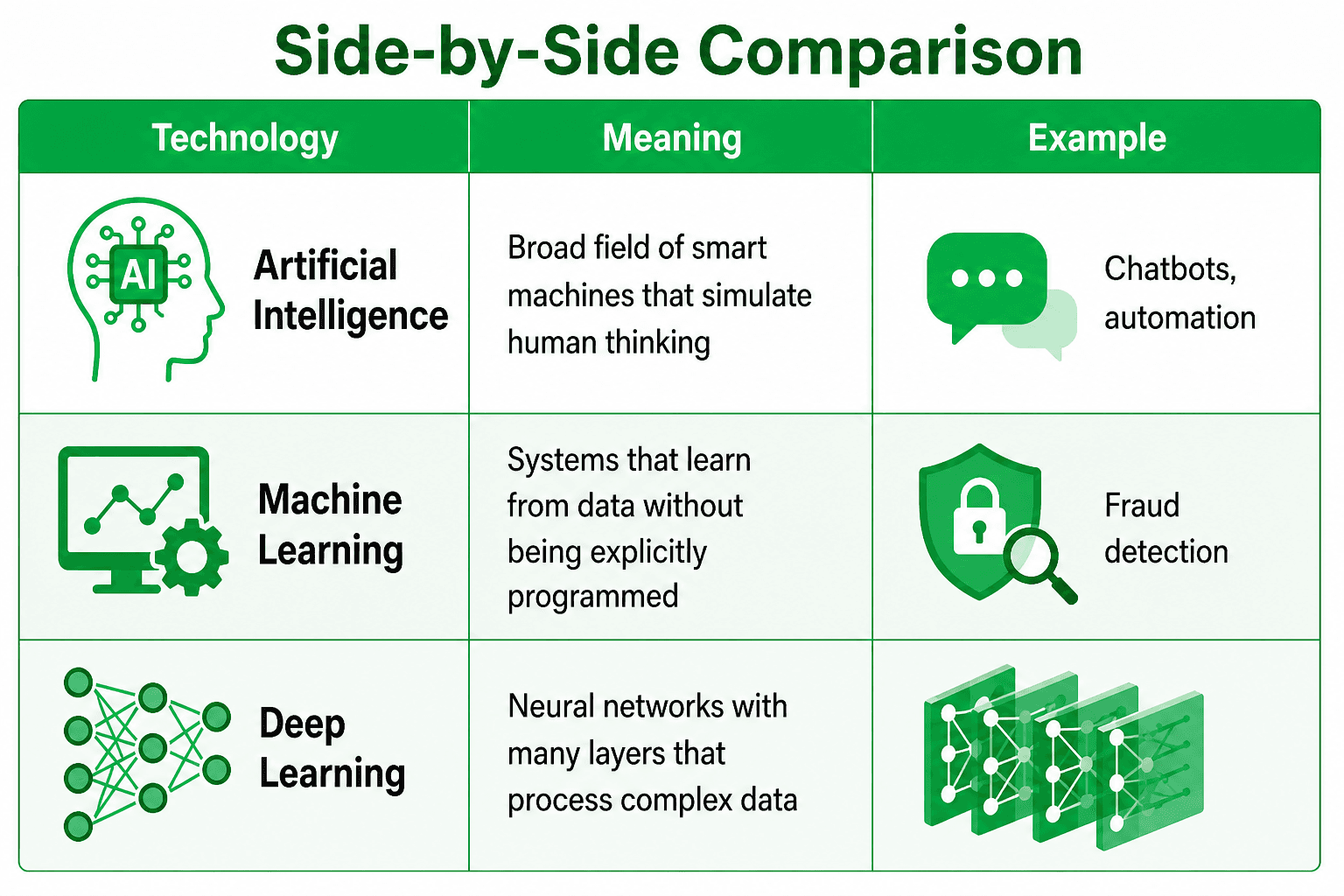
Yes. Deep learning is a specialized subset of machine learning, which itself is a subset of artificial intelligence.
Where is deep learning used?
It is widely used in healthcare (diagnosis), finance (fraud detection), retail (recommendations), cybersecurity (threat detection), robotics (automation), and generative AI (text, images, and video).
Why is deep learning important?
Deep learning enables machines to solve problems that were previously too complex, such as recognizing images, understanding language, and making real-time decisions at scale.
What are examples of deep learning?
Examples include voice assistants, facial recognition systems, self-driving cars, recommendation engines, and AI tools that generate text, images, and video.
What is a neural network?
A neural network is a system of algorithms inspired by the human brain. It consists of layers of nodes (neurons) that process and pass information forward.
What is the difference between machine learning and deep learning?
Machine learning often requires manual feature selection, while deep learning automatically learns features from raw data using layered neural networks.
Does deep learning require a lot of data?
Yes. Deep learning models typically perform best with large datasets because more data helps them learn more accurate patterns.
Is deep learning the same as AI?
No. Deep learning is one technique within AI. AI is the broader field that includes many approaches, including rule-based systems and traditional machine learning.
What are the challenges of deep learning?
Deep learning requires large amounts of data, high computational power, and can be difficult to interpret. It can also inherit biases from the data it is trained on.
Can deep learning improve over time?
Yes. With more data and continued training, deep learning models can improve accuracy and adapt to new patterns.
What industries benefit the most from deep learning?
Industries with large amounts of data benefit the most, including healthcare, finance, technology, retail, and transportation.
Conclusion
Deep learning is one of the most important technologies in modern AI because it allows machines to learn complex patterns from data instead of relying on fixed rules. That capability powers voice assistants, recommendations, medical tools, autonomous vehicles, and much more.
As data grows and computing improves, deep learning will continue shaping how businesses operate and how people interact with technology.
Photo Credit:Alexander Sikov