RPA vs Enterprise Automation: What’s the Difference?

Learn how robotic process automation compares to enterprise automation, key use cases, benefits, examples, costs, and how to choose the right strategy in 2026.
Are you trying to decide between RPA vs enterprise automation and wondering which one will actually move your business forward?
You are not alone. Many companies start with automation to save time, reduce errors, and remove repetitive work. But they quickly discover that not all automation is the same.
Some tools automate a single task. Others automate entire business operations across teams, systems, and workflows. That is where the confusion begins.
Should you use robotic process automation (RPA) for quick wins? Or invest in enterprise automation for long-term scale, efficiency, and growth?
In this guide, we will break down the real difference, compare use cases, explain costs, and help you choose the right path for your business in 2026.
What Is RPA?
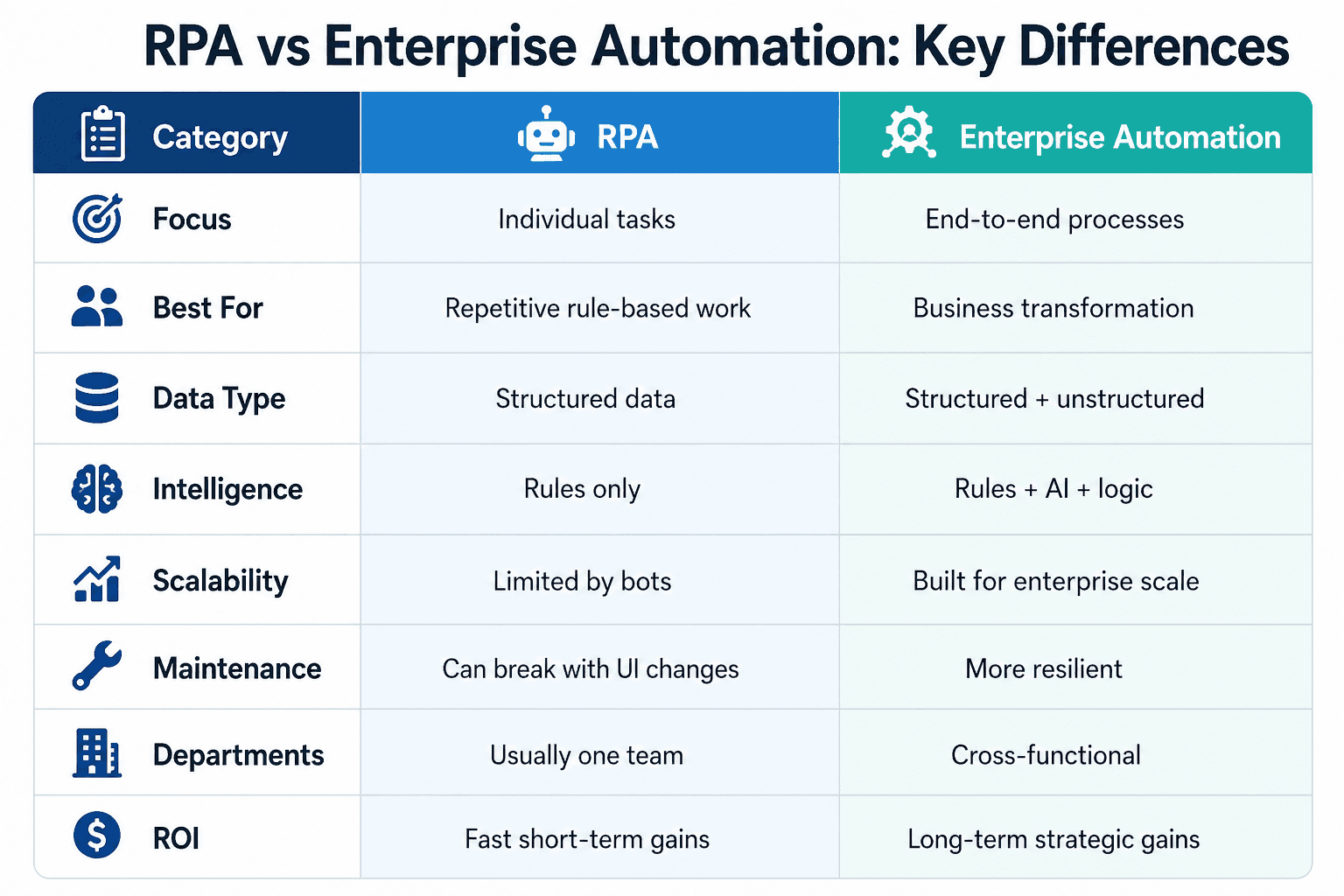
RPA (Robotic Process Automation) uses software bots to mimic repetitive human actions inside applications.
These bots follow rules and complete structured tasks such as:
Copying data from one system to another
Logging into applications
Moving files
Generating reports
Filling forms
Updating records
Think of RPA as a digital worker that repeats the same steps over and over.
Simple Example of RPA
A finance team receives 500 invoices every week.
An RPA bot opens emails, downloads attachments, copies invoice totals into the ERP system, and files each invoice automatically.
That saves hours of manual work.
What Is Enterprise Automation?
Enterprise automation is broader than RPA.
It connects systems, people, workflows, data, approvals, AI, and decision-making across the business.
Instead of automating one task, enterprise automation improves the full process from start to finish.
It may include:
Workflow automation
API integrations
AI automation
Document processing
Human approvals
Analytics
Process orchestration
Cross-department workflows
Customer and employee self-service
Think of enterprise automation as an operating model for modern business efficiency.
When to Use RPA
RPA is a strong choice when the task is repetitive, stable, and rules-based.
Best RPA Use Cases
Finance
Invoice entry
Reconciliation
Expense uploads
HR
Employee data entry
Payroll file transfers
Benefits updates
Operations
Report generation
Data migration
Form processing
Customer Support
Ticket categorization
Updating records
Password reset workflows
If a person clicks the same buttons every day, RPA may help.
When to Use Enterprise Automation
Enterprise automation is better when processes involve multiple systems, approvals, teams, and changing conditions.
Best Enterprise Automation Use Cases
Employee Onboarding
Create accounts, route approvals, assign training, ship equipment, and notify managers automatically.
IT Service Management
Detect issues, create tickets, route requests, resolve common problems, and notify users.
Sales Operations
Sync CRM, trigger follow-ups, enrich leads, create proposals, and update dashboards.
Customer Support
Use AI to answer questions, route escalations, summarize conversations, and track outcomes.
Compliance & Risk
Monitor workflows, collect evidence, flag issues, and create audit trails.
Is RPA Replaced by Enterprise Automation?
Not exactly.
RPA is still useful. But many businesses now treat RPA as one piece of a larger automation strategy.
In modern organizations:
RPA handles repetitive UI tasks
APIs connect systems directly
AI interprets documents and language
Workflow engines manage approvals
Analytics measure outcomes
Humans handle exceptions
The smartest companies combine them.
Common Problems with RPA Alone
RPA can create value, but relying only on bots can become difficult over time.
Challenges
Bots break when screens change
Exceptions require manual fixes
Scaling hundreds of bots gets expensive
Limited intelligence
Harder governance across teams
Maintenance burden grows over time
That is why many organizations evolve beyond basic task automation.
Benefits of Enterprise Automation
Why are more companies moving toward enterprise automation?
Because the way businesses operate is fundamentally changing. Companies are under constant pressure to move faster, do more with less, and deliver better experiences—while managing increasing complexity across systems, teams, and data. Traditional approaches built on manual processes, disconnected tools, and siloed departments simply can’t keep up.
Enterprise automation addresses this gap by connecting workflows end-to-end, reducing human friction, and introducing intelligence into everyday operations. Instead of automating isolated tasks, it transforms entire processes—creating a more efficient, scalable, and resilient organization.
It’s not just about cost savings. It’s about speed, consistency, visibility, and the ability to make better decisions in real time. As AI becomes more embedded into workflows, companies are also gaining a competitive advantage by turning their data into actionable insights rather than letting it sit unused.
In short, enterprise automation is becoming a core operating model—not a nice-to-have—because it enables companies to grow without adding complexity at the same rate.
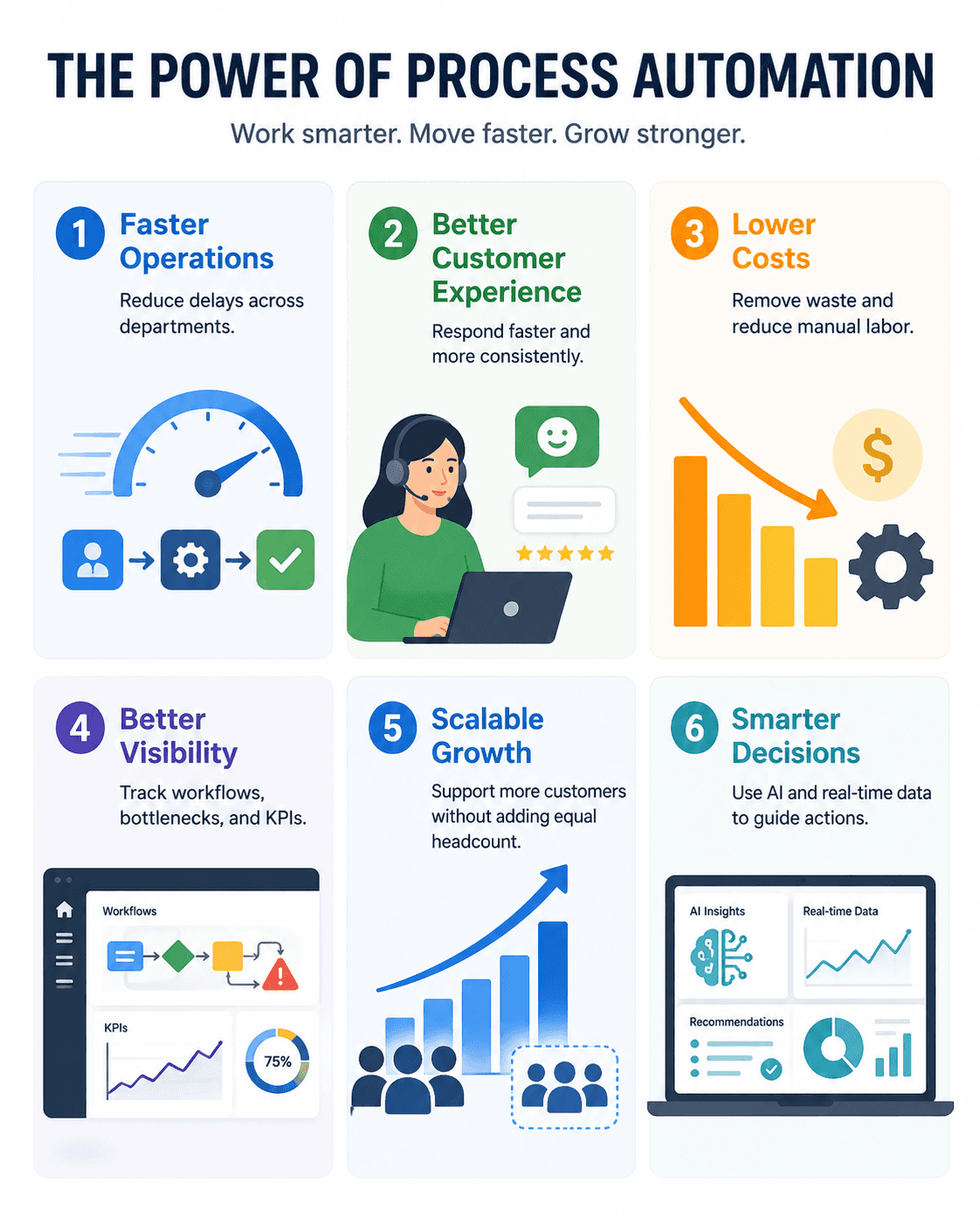
Here are the key benefits driving that shift:
Major Benefits
How to Choose: RPA vs Enterprise Automation
Ask these questions:
Choose RPA If:
You need quick wins
The process is repetitive
Inputs are structured
One department owns the workflow
Budget is smaller
Choose Enterprise Automation If:
Multiple systems are involved
Workflows cross departments
You need approvals and governance
Inputs include emails, PDFs, chats, or documents
Growth and scale matter
Customer experience matters
Final Verdict
The real question is not RPA vs enterprise automation. The real question is: What level of automation does your business need now—and what will it need next? If you need quick task automation, RPA can be a great start.
If you want scalable operations, connected systems, AI-driven workflows, and business growth, enterprise automation is the future. The best strategy for many businesses is simple:
Start with the right use case. Build toward enterprise-wide automation.
Frequently Asked Questions
Is RPA the same as enterprise automation?
No. RPA focuses on automating specific repetitive tasks, often by mimicking human actions in software. Enterprise automation is broader and connects people, systems, data, and workflows across the business.
Is enterprise automation better than RPA?
Not always. It depends on the problem you are solving. If you need a quick fix for repetitive manual work, RPA can be effective. If you want long-term efficiency and transformation, enterprise automation is often the better path.
Can RPA be part of enterprise automation?
Yes. Many organizations use RPA as one tool within a larger enterprise automation strategy that may also include AI, APIs, workflow orchestration, and analytics.
Does enterprise automation use AI?
Often yes. Many platforms use AI for decision-making, document processing, predictive insights, chatbots, and customer interactions.
When should a company choose RPA?
RPA is a strong fit when tasks are repetitive, rules-based, high-volume, and performed in legacy systems without easy integrations.
When should a company choose enterprise automation?
Choose enterprise automation when processes span multiple departments, require approvals, involve structured and unstructured data, or need scalability across the organization.
Is RPA cheaper to implement?
Usually upfront, yes. RPA can deliver quick wins with lower initial investment. However, maintenance costs can rise over time if many bots are needed.
Why do RPA bots break?
Bots often depend on screen layouts and user interfaces. If an application changes buttons, fields, or page structure, the bot may fail and need updates.
Can enterprise automation work with old systems?
Yes. Many enterprise automation platforms integrate with legacy systems using APIs, connectors, databases, and sometimes RPA when needed.
Which delivers faster ROI?
RPA often delivers faster short-term ROI. Enterprise automation may take longer but can produce larger and more strategic long-term returns.
Do small businesses need enterprise automation?
Sometimes. Smaller companies may start with simple workflow automation and expand over time as operations become more complex.
Can enterprise automation reduce headcount?
It can reduce manual workload and reallocate employees to higher-value tasks, but the best outcomes usually come from productivity gains rather than simple cost-cutting.
Ready to bring AI into your workflows? See how AskBobAI helps your team get instant answers, automate repetitive work, and stay consistent across support, operations, compliance, and more. Book a demo today and see it in action.
Photo Credit:NicoElNino