2026 Fannie Mae Selling Guide Updates: What Lenders Need to Know
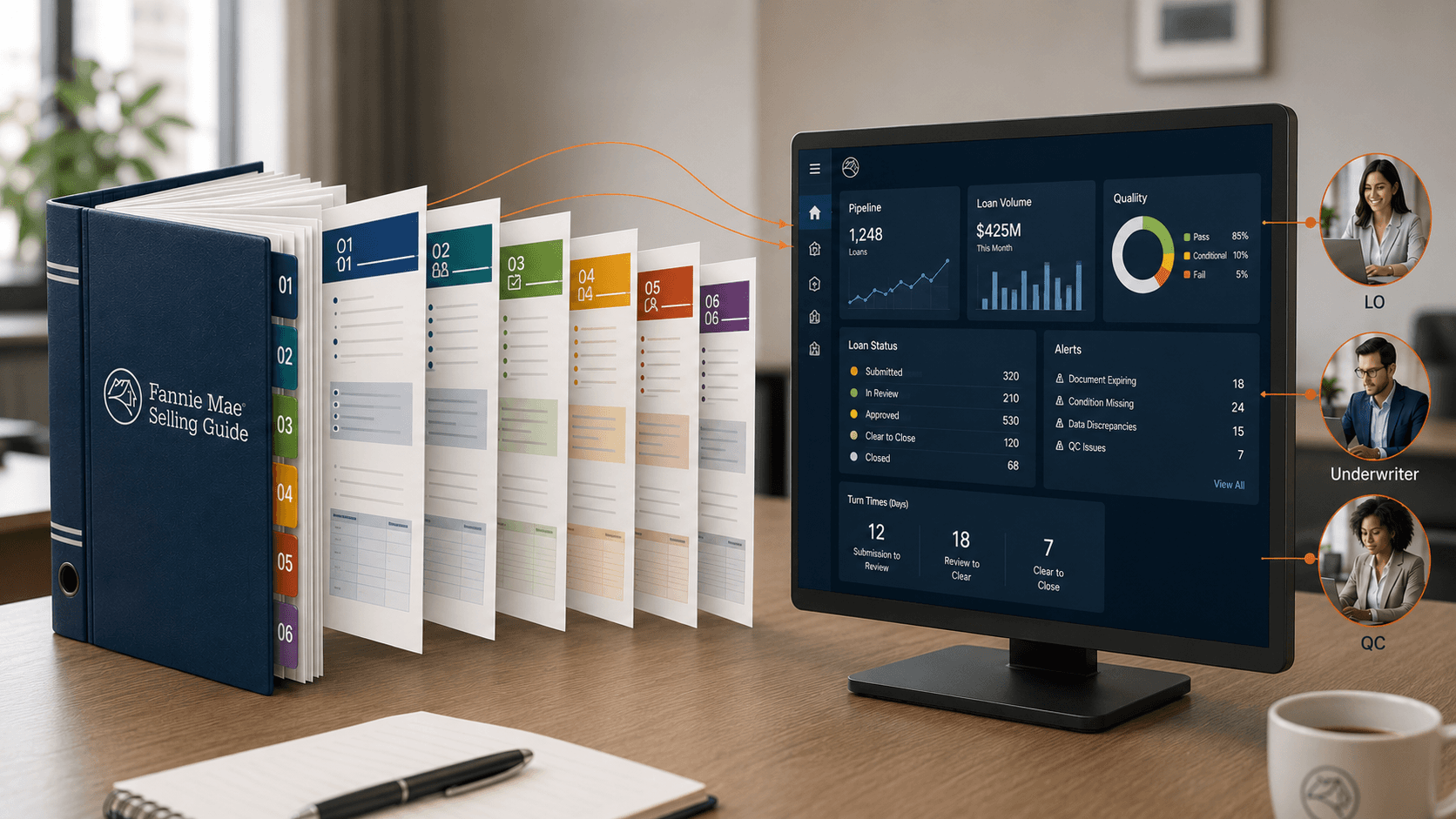
Five Fannie Mae Selling Guide updates have already shipped in 2026, from SEL-2026-01 on February 4 through SEL-2026-05 on May 6, each rewriting eligibility, documentation, or process rules across the Selling Guide.
“The opportunity for Fannie Mae Selling Guide updates in 2026 is operational speed.” ASKBOBAI |
The opportunity for Fannie Mae Selling Guide updates in 2026 is operational speed. Lenders that route every announcement through a governed interpretation workflow, with grounded guideline intelligence at the desk, operationalize policy changes inside the effective-date window. The result is faster correct answers, cleaner audit trails, and fewer downstream defects.
What Are Fannie Mae Selling Guide Updates?
Fannie Mae Selling Guide updates are formal policy revisions issued through numbered Selling Guide Announcements (the SEL series) and Lender Letters that rewrite the Selling Guide's eligibility, documentation, underwriting, delivery, and quality control requirements. The Selling Guide is republished on a regular cadence, and as of 2024 Fannie Mae moved publication to the first Wednesday of the month.
Each Announcement carries its own effective date, often a mix of dates by section. Lenders are accountable for applying every change to every loan in scope, whether the staff member at the desk has read it or not.
Why Fannie Mae Selling Guide Updates Matter in 2026
The pace of change is the first reason. SEL-2026-04, published April 22, 2026, added VantageScore 4.0 and FICO Score 10T as approved credit score models, the most significant credit-scoring change in two decades. Fannie Mae estimates credit score modernization will reduce costs for American consumers and mortgage lenders by as much as $1 billion in the first year of competition.
The complexity of each Announcement is the second reason. SEL-2026-02, issued March 4, 2026, restructured Chapter B3-3 Income Assessment and clarified appraisal review options for Texas Section 50(a)(6) loans. The income revisions are effective for applications on or after June 1, 2026, with optional immediate application. An LO who quotes last year's income policy in May will quote the wrong policy in June.
The governance environment is the third reason. Fannie Mae Lender Letter LL-2026-04, issued April 8, 2026, takes effect August 6, 2026 and requires a documented AI governance program, training, a designated internal overseer, and lender accountability for vendor AI use. Any assistant that interprets the Selling Guide sits inside an examiner-visible control plane.
How Lenders Interpret Selling Guide Updates at Scale
A working interpretation program in 2026 follows six steps.
1. 1. Ingest the Announcement on day one. Policy and compliance owns intake. The Announcement, the redlined Selling Guide pages, and related Bulletins land in the same workspace the same day they publish. The Selling Policy Communications page is the canonical feed.
2. 2. Map each change to the lender's playbook. Every revised section is tagged to the lender's product matrices, underwriting checklists, LOS configurations, QC plan, and training materials.
3. 3. Calendar the effective dates. One Announcement often carries several dates. SEL-2026-05 made most revisions effective May 6, 2026, but set August 6, 2026 for co-op project eligibility changes. The calendar drives staff readiness, system cutovers, and pipeline communications.
4. 4. Update systems and decisioning. LOS, POS, pricing, and Desktop Underwriter (DU) settings are reconfigured to match the revised policy. SEL-2026-03, published April 1, 2026, updated the DU archival policy and employer-level income validation, configuration changes that touch every active casefile.
5. 5. Train staff and refresh desk references. LOs, processors, underwriters, closers, and post-close QC analysts each get a tailored summary plus updated job aids. This is where most lenders lose time.
6. 6. Monitor and audit the rollout. Prefunding and post-close QC sample against the new requirements. Trend reports surface any rising defect category tied to a recent policy change, and drift routes back to training and the map.
Selling Guide Updates by Function
Each function inside a lender reads the same Announcement through a different lens.
Loan officers and processors
The LO needs the borrower-facing answer in seconds, not the chapter number. After SEL-2026-04, the LO has to answer VantageScore 4.0 eligibility questions on the spot. Lenders not in the limited rollout must continue to use Classic FICO scores from each bureau through a tri-merge credit report, and the LO has to know which list their company sits on.
Underwriters
Underwriters live in the chapters. SEL-2026-02's restructured Chapter B3-3 introduces consolidated tables for each income type, and the underwriter has to know which version applies based on the application date and the immediate-application election.
Post-closing quality control
QC samples loans against the policy in effect at the time of the loan, not at the time of the audit. With five SEL Announcements already issued in 2026, QC needs a clean way to ask which version of a requirement applied to a March 15 versus April 30 versus May 10 casefile.
Training and policy
Training and policy translate every Announcement into job aids, e-learnings, and updated procedures. The opportunity is to do that translation once, against a single source of truth.
Without AI vs. With AI: A Concrete Comparison
Workflow on a new SEL Announcement | Without AI | With AI in production |
|---|---|---|
Reading the Announcement on day one | Compliance circulates a PDF; staff read on their own time | Grounded assistant ingests the Announcement and redlined sections the same day |
Answering "Can my borrower use VantageScore 4.0 today?" | LO emails compliance, waits hours for a stale answer | Assistant returns the SEL-2026-04 citation and lender's participation status in seconds |
Reconciling a March file against the new B3-3 income tables | Underwriter rereads the chapter cover to cover | Assistant returns the version of B3-3 in effect on the application date with the exact passage |
Picking the right effective date inside one Announcement | Staff squint at PDF footnotes | Assistant returns the effective date for each section, including exceptions |
Producing a change log for an examiner | Manual rebuild across email threads and SharePoint | Standing log generated from the governed assistant's update history |
Real-World Anchors
SEL-2026-04 and the VantageScore 4.0 rollout
SEL-2026-04, effective April 22, 2026, added VantageScore 4.0 and FICO Score 10T to the approved credit score models. ABA Banking Journal covered the joint FHFA and HUD rollout enabling immediate VantageScore 4.0 use across Fannie Mae, Freddie Mac, and FHA. Every LO script, disclosure, and pricing engine that referenced Classic FICO is now in scope.
SEL-2026-02 and Chapter B3-3 Income Assessment
SEL-2026-02, issued March 4, 2026, restructured Chapter B3-3 and clarified appraisal review options for Texas Section 50(a)(6) loans. Two effective dates inside one Announcement (March 4 for the appraisal clarification, June 1 for the income changes) puts every underwriter on a split timeline.
SEL-2025-10 and HomeStyle Refresh
SEL-2025-10, published December 2025, introduced HomeStyle Refresh, eliminated the 3 percent acceptability requirement for 7- and 10-year ARMs, and expanded property eligibility for ADUs and manufactured homes. HousingWire's coverage tracked the March 31, 2026 effective dates, the kind of multi-section announcement that drives most of the rework.
Benefits of Operationalizing Selling Guide Updates Faster
Faster correct answers at the desk. Grounded guideline intelligence cuts the lookup from minutes to seconds, with the citation attached.
Cleaner effective-date management. A governed map of every change against the lender's playbook turns a 30-page Announcement into a calendar the business can run on.
Lower defect rate on policy churn. Policy-related findings follow rapid change. Operationalizing each SEL the day it lands shrinks the window in which the desk applies the wrong version.
A defensible record for examiners. Under LL-2026-04, the assistant that interprets the Selling Guide sits inside a documented governance program, with a standing change log and a citation behind every answer.
Common Mistakes to Avoid
Treating each Announcement as a one-off email. A PDF and a Friday summary do not survive a busy desk. The map, calendar, and assistant need to be standing assets.
Skipping the grounding step. A generic LLM not pointed at the current Selling Guide, the historical sections, and the lender's own policy will return confident, wrong answers. SEL-2026-02 alone has two effective dates a non-grounded model will conflate.
Letting the assistant make the policy decision. The assistant proposes, cites, and explains. The credit policy committee, underwriting management, and the QC chief still own the decision.
Underestimating Lender Letter and Bulletin scope. SEL Announcements are not the only updates. Lender Letters, Notices, DU release notes, and Bulletins all sit inside the same interpretation workflow.
How AskBobAI Powers Selling Guide Interpretation at Scale
AskBobai is a function-specific and industry-specific platform for mortgage teams that need answers grounded in the current Fannie Mae Selling Guide, every active Selling Guide Announcement, the Seller/Servicer Guide, FHA Handbook 4000.1, VA Lenders Handbook, USDA guidance, and the lender's own policy.
Every response is sourced and cited back to the underlying paragraph, so an LO, underwriter, or QC analyst can see the exact passage behind the answer in one click. AskBobai does not extract data from loan files.
Three capabilities map directly to Selling Guide interpretation at scale. Guideline intelligence across Fannie Mae, Freddie Mac, FHA, VA, and USDA gives the assistant the authoritative reference set for every policy question on the desk. The document comparison tool reads a new Announcement against the prior version and surfaces what changed, in plain language, with citations.
The bulk query tool runs hundreds of policy questions across thousands of loans or files at once, the pattern behind monthly QC trend reporting and prefunding readiness checks.
Governance and compliance architecture sit underneath, with role-based access, audit logs, retention controls, and a standing record of every guideline answer the assistant has returned. See the AskBobAI mortgage solutions page for the full capability map.
The Future of Selling Guide Operationalization
Policy intake moves from email to a governed workspace an examiner can read end to end.
Document comparison becomes a standing artifact. Every SEL ships with a machine-generated change view against the prior Selling Guide, with the lender's playbook deltas mapped against each change.
Effective-date intelligence becomes a service. The system that knows which version of a section applied on which date is the daily reference for underwriting and QC.
Vendor governance follows the assistant. Under LL-2026-04, the guideline assistant ships with model cards, audit logs, and a human-in-the-loop pattern.
Cross-guide reasoning becomes the norm, with the same workflow reading the Freddie Mac, FHA, VA, and USDA equivalents.
Final Thoughts
The opportunity in 2026 is to treat Selling Guide updates as a standing operational program, not a series of one-off PDFs.
Five Announcements through May, the credit score modernization rollout, the restructured income assessment chapter, and the August 6 AI governance deadline all land this year.
Lenders that route every announcement through a grounded, cited, governed guideline assistant push correct answers to LOs, underwriters, and QC analysts inside the effective-date window.
The next Announcement lands on a system that already knows how to absorb it.
For a deeper look at the broader toolkit, see Mortgage AI Tools.
Frequently Asked Questions
Q. What are Fannie Mae Selling Guide updates?
Fannie Mae Selling Guide updates are formal revisions issued through numbered Selling Guide Announcements (the SEL series), Lender Letters, and Notices.
Each update rewrites eligibility, documentation, underwriting, delivery, or QC requirements and carries its own effective date.
Lenders are accountable for applying each change to every loan in scope from the effective date forward.
Q. How often does Fannie Mae publish Selling Guide updates?
The Selling Guide is republished on a regular monthly cadence, and as of 2024 publication moved to the first Wednesday of the month.
Through the first five months of 2026, Fannie Mae issued five Selling Guide Announcements, plus Lender Letters and Notices.
Q. What did SEL-2026-04 change?
SEL-2026-04, effective April 22, 2026, added VantageScore 4.0 and FICO Score 10T as approved credit score models. VantageScore 4.0 is available now through a limited rollout.
Lenders not in the rollout must continue to use Classic FICO scores from each bureau through a tri-merge credit report until VantageScore 4.0 is broadly available.
Q. What did SEL-2026-02 change about income assessment?
SEL-2026-02, issued March 4, 2026, restructured Chapter B3-3 Income Assessment into a modular format with standard tables for each income type that consolidate documentation, history, continuity, and calculation requirements.
The revisions are effective for applications on or after June 1, 2026, with optional immediate application.
Q. What does the Fannie Mae AI governance framework require?
Lender Letter LL-2026-04, issued April 8, 2026 and effective August 6, 2026, requires a documented AI governance program, staff training, a designated internal overseer, and lender accountability for vendor AI use. Any assistant that interprets the Selling Guide sits inside that framework.