What Is a CDP? Customer Data Platform Guide for 2026
Every company says they want to know their customers better. Most already have more data than they know what to do with. It pours in from websites, CRMs, email platforms, support systems, ecommerce stores, mobile apps, and advertising channels every single day.
Yet despite all of that data, many businesses still operate in the dark. Information is trapped in separate systems, duplicated across tools, outdated by the time it is reviewed, and nearly impossible to use when fast decisions matter most.
That is the real problem of modern growth: not a lack of customer data, but a failure to turn it into intelligence.
This is exactly why the Customer Data Platform (CDP) has become one of the most important systems in today’s technology stack. A CDP helps organizations unify customer data, understand behavior, and act in real time across marketing, sales, service, and AI-driven workflows.
And the urgency is growing. According to a Prosper Insights & Analytics survey highlighted by Forbes, 86% of consumers research products online before buying in-store, proving that digital behavior now influences even offline revenue. The same source found that organizations using modern CDP capabilities have seen up to a 9.1x greater increase in customer satisfaction, driven by more connected and relevant experiences. At the same time, nearly 60% of consumers say they do not like being tracked, making privacy-first personalization more critical than ever.
The message is clear: customers expect relevance, speed, and trust—all at once. Businesses that can unify data and respond intelligently will win. Those that cannot will keep collecting data while falling behind.
In this guide, you’ll learn what a CDP really is, how leading platforms work, why the category matters more than ever in 2026, how CDPs compare to CRMs and data warehouses, where AI is reshaping the market, and what to evaluate before investing in the right solution.
What Is a Customer Data Platform?
Before diving into the history of customer data systems, it helps to clearly define what a CDP is and why it matters today.
A Customer Data Platform is software that collects customer data from multiple sources, combines it into one persistent profile, and makes that profile available for activation, analytics, personalization, and decision-making.
In simple terms, a CDP turns scattered customer information into one usable source of truth. Instead of separate records across different tools, teams and systems work from one connected view of the customer. That leads to faster decisions, better targeting, stronger customer experiences, and more efficient growth.
Today’s leading CDPs go beyond storage. They help businesses react in real time, personalize customer experiences, support AI models, and continuously improve decisions through live feedback loops.
The Evolution of Customer Data Management
To understand why CDPs became necessary, it helps to look at how customer data management has evolved over time. Each era solved one problem while creating the need for the next generation of tools.
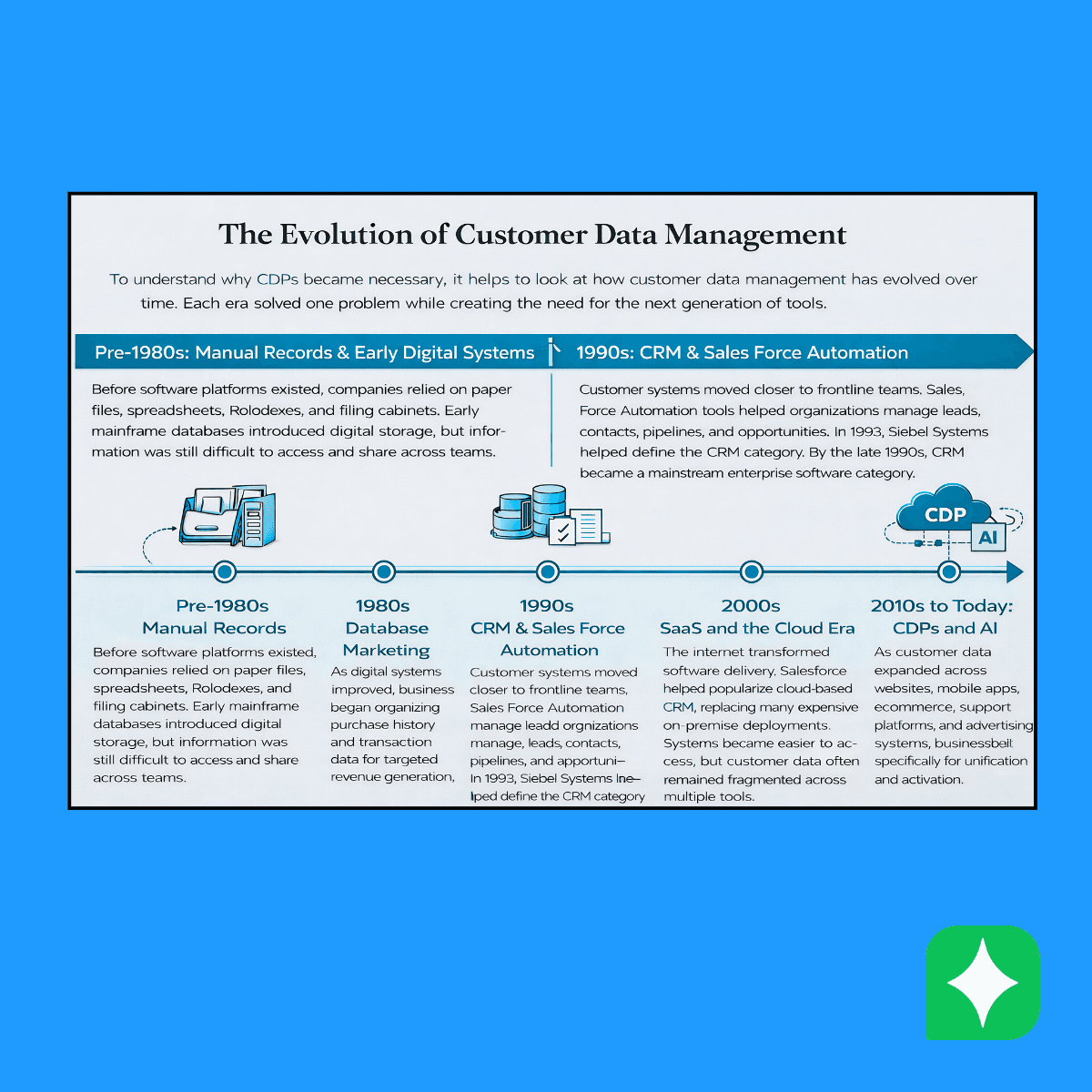
Pre-1980s: Manual Records & Early Digital Systems
Before software platforms existed, companies relied on paper files, spreadsheets, Rolodexes, and filing cabinets. Early mainframe databases introduced digital storage, but information was still difficult to access and share across teams.
1980s: Database Marketing
As digital systems improved, businesses began organizing purchase history and transaction data for targeted campaigns. Customer data started shifting from recordkeeping to revenue generation.
1990s: CRM & Sales Force Automation
Customer systems moved closer to frontline teams. Sales Force Automation tools helped organizations manage leads, contacts, pipelines, and opportunities. In 1993, Siebel Systems helped define the CRM category. By the late 1990s, CRM became a mainstream enterprise software category.
2000s: SaaS and the Cloud Era
The internet transformed software delivery. Salesforce helped popularize cloud-based CRM, replacing many expensive on-premise deployments. Systems became easier to access, but customer data often remained fragmented across multiple tools.
2010s to Today: CDPs and AI
As customer data expanded across websites, mobile apps, ecommerce, support platforms, and advertising systems, businesses needed a platform built specifically for unification and activation. That led to the rise of the CDP.
Now the category is evolving again through AI, predictive analytics, and real-time decisioning. Modern platforms are expected not only to organize data, but to help companies act on it instantly.
The mission has stayed the same across every era: create a complete customer view and turn that intelligence into growth.
Why CDPs Matter in 2026
The role of the CDP has changed significantly over the last few years. What began as a tool for data unification is now becoming a foundation for intelligent growth.
Earlier generations of CDPs focused mainly on storing profiles and syncing data between systems. That is still valuable, but modern organizations need more. Businesses now require platforms that can react instantly, personalize automatically, and support AI-driven decisions at scale.
The modern CDP is no longer just a database. It is becoming the operating layer for customer intelligence.
AI systems depend on unified customer context to work effectively. Without accurate profiles, AI recommendations become weaker, automation becomes generic, and personalization fails to reach its potential.
With the right CDP, businesses can:
Connect data from every major source
Resolve identities across devices and channels
Maintain live customer profiles
Trigger real-time personalization
Improve retention strategies
Support predictive analytics
Feed AI agents with trusted data
Enforce privacy and consent rules
That is why CDPs are becoming more important across nearly every industry.
How a CDP Works
If you lead marketing, growth, customer experience, ecommerce, or digital transformation, this is the section that matters most. You may already understand that customer data is valuable—but the real question is how that data becomes revenue, retention, and better customer experiences.
That is where a Customer Data Platform (CDP) earns its value. A CDP is not just another place to store records. It is the system that takes scattered customer activity, turns it into usable intelligence, and helps your business act at the right moment.
Whether you are trying to improve conversions, reduce churn, personalize journeys, increase campaign efficiency, or prepare your organization for AI, the mechanics behind a CDP matter. When you understand how it works, you understand why some companies grow faster than others with the same amount of data.
No matter the vendor, every serious CDP performs four core jobs.
1. Collect Data
Everything starts with inputs. Customer data is created across dozens of touchpoints every day.
Examples include:
Website visits
Mobile app activity
CRM updates
Purchases
Email engagement
Support tickets
Ad clicks
Loyalty activity
Call center interactions
A CDP ingests these signals through APIs, connectors, SDKs, imports, and webhooks. The goal is completeness. Better inputs create better decisions.
2. Unify Profiles
Once data is collected, it must be organized into something usable. Raw data usually arrives with different identifiers across systems.
One tool may know an email address. Another sees a device ID. Another stores a phone number or customer account number.
The CDP resolves these fragments into one persistent profile through identity matching, deduplication, cleanup, and ongoing enrichment. The result is a living customer record that improves with every interaction.
3. Decide Intelligently
After data is unified, the next step is turning information into action. This is where modern CDPs separate themselves from basic systems.
Traditional tools rely on static segments and manual rules. Advanced CDPs apply AI and machine learning to determine what should happen next.
Examples include:
Churn prediction
Next best action
Offer recommendations
Channel selection
Timing optimization
Audience discovery
4. Activate Across Channels
Insights only matter when they lead to execution. The final step is activating decisions wherever customers engage.
This may include:
Email
SMS
Push notifications
Paid media
In-app messaging
Sales alerts
Support workflows
Direct mail
The best CDPs also learn from results immediately. If a customer opens, clicks, purchases, or ignores a message, the profile updates and improves the next action.
The Customer Intelligence Loop
If you are evaluating a CDP, this may be the most important concept to understand. Many platforms can collect data. Many tools can build reports. Some can even trigger campaigns. But the real competitive advantage comes from how quickly your business can learn from customer behavior and turn that learning into better action.
That is where the Customer Intelligence Loop matters. It is the operating model behind modern customer growth. Instead of treating every interaction as a one-time event, the business uses each customer signal to improve the next decision. Over time, this creates smarter marketing, better customer experiences, stronger retention, and more efficient revenue growth.
The true power of a CDP is not just data storage. It is the continuous learning cycle it enables across the entire customer journey.
The loop looks like this:
Collect → Unify → Understand → Decide → Engage → Repeat
A customer visits a pricing page. The CDP updates the profile instantly. AI evaluates the full context. The platform determines the best next action. A personalized experience is delivered. The customer’s response flows back into the profile.
Every interaction teaches the system something new. That is the difference between simply storing data and continuously learning from it.
Before and After a CDP
The impact of a CDP becomes easiest to understand when comparing how teams operate before and after implementation.
Without a CDP
When customer data remains fragmented, organizations often experience:
Days of waiting for audience lists
Data silos across teams
Weak attribution models
Manual campaign execution
Generic customer messaging
Delayed reporting
With a CDP
Once customer data is unified, teams gain:
Self-service segmentation in minutes
Connected customer profiles
Better attribution visibility
Faster campaign launches
Personalized experiences
Smarter decisions
With a CDP + AI
When AI is layered into the platform, the operating model evolves even further:
AI discovers high-value segments
AI predicts churn risk
AI selects the next best action
AI optimizes spend allocation
AI tests and learns continuously
Teams focus on strategy instead of manual operations
The biggest change is not just efficiency. It is the ability to improve with every interaction.
CDP Use Cases
Most organizations adopt a CDP in stages. They begin by solving data problems, then improve activation, and eventually unlock AI-driven growth opportunities.
Unified Customer View
This is often the first major win. Records from multiple systems are merged into one accurate profile. That improves reporting, customer counts, and lifetime value calculations.
Personalization
Once profiles are connected, businesses can tailor content, offers, and messaging based on customer behavior, preferences, and purchase history.
Smarter Advertising
A CDP helps suppress converted customers from acquisition campaigns while building stronger lookalike audiences from high-value profiles.
Customer Journeys
Organizations can automate journeys that adapt based on engagement, timing, and behavior signals across channels.
Retention
AI and predictive models can identify at-risk customers early and trigger interventions before churn happens.
Revenue Optimization
Budget can be shifted toward the audiences and channels most likely to generate incremental return.
AI-Powered Growth
At the most advanced stage, AI agents can decide, act, measure results, and improve customer experiences continuously.
CDP vs CRM vs Data Warehouse vs DMP
Many businesses compare these systems when evaluating their technology stack. While they all touch data, each serves a different purpose.
CDP
Best for unified customer profiles, activation, personalization, and AI-driven engagement.
CRM
Best for managing pipelines, contacts, accounts, opportunities, and support relationships.
Cloud Data Warehouse
Best for analytics, dashboards, historical reporting, and storing large datasets.
DMP
Traditionally used for anonymous ad targeting. Its importance has declined as third-party cookies disappear and privacy regulations increase.
The right technology stack often includes multiple systems. But when the goal is connected customer intelligence and real-time action, the CDP becomes central.
CDP vs Knowledge Management: Why Modern Businesses Need Both
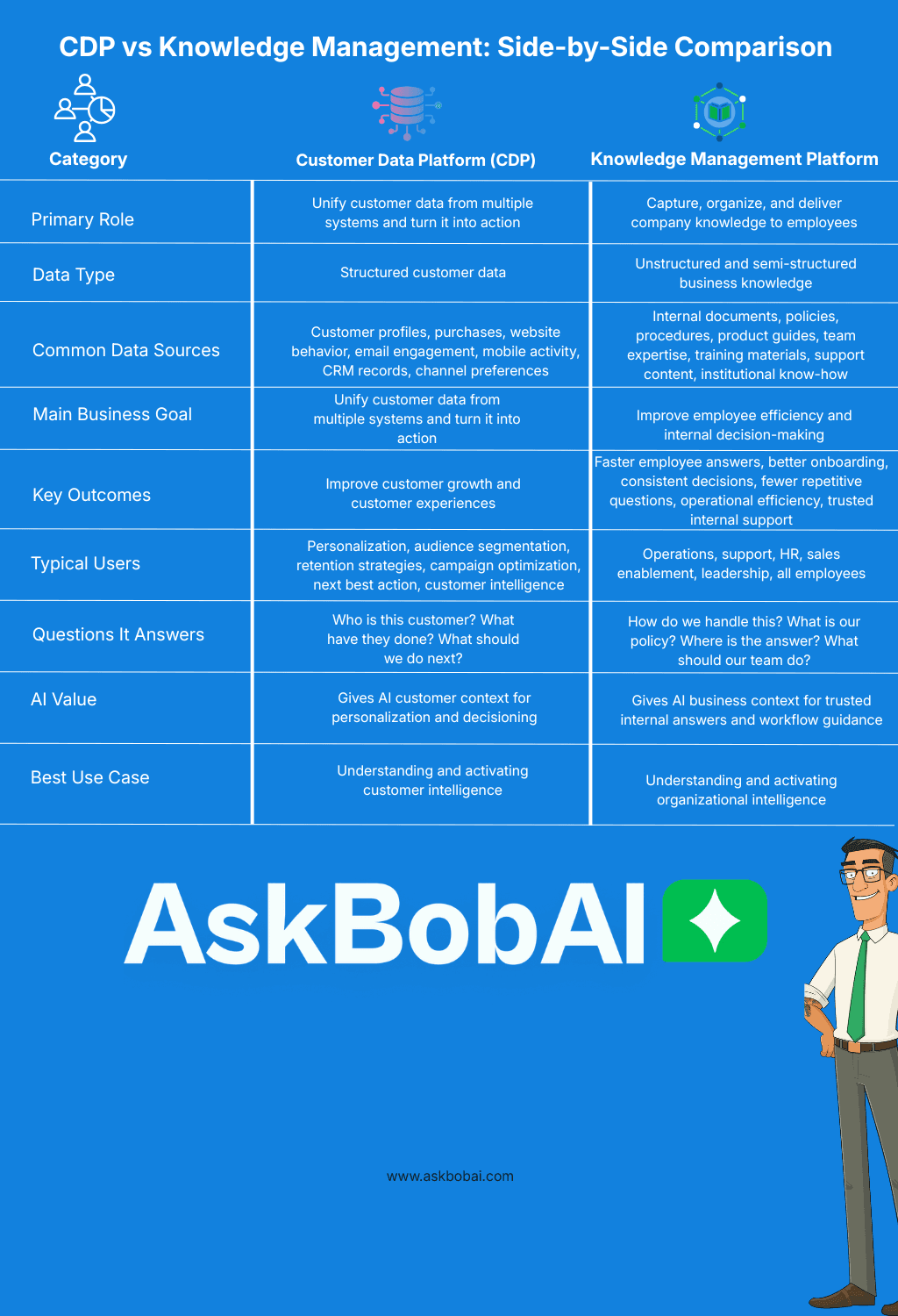
Many companies compare a Customer Data Platform (CDP) and Knowledge Management (KM) software because both organize information. But they are not competing categories. They solve different business problems—and together, they become far more powerful.
A CDP helps your business understand the customer. A Knowledge Management platform helps your business understand itself.
That distinction matters. One drives smarter external experiences. The other drives smarter internal execution.
Side-by-Side Comparison
Why This Matters
Many organizations invest heavily in customer systems while internal knowledge remains trapped across folders, wikis, shared drives, inboxes, and employee expertise. That creates a hidden cost: teams move slower, decisions become inconsistent, onboarding takes longer, and valuable knowledge stays locked inside the business.
At the same time, customer-facing teams need unified profiles and real-time context to personalize experiences and drive growth.
That is why modern businesses increasingly need both systems working together.
Where AskBobAI Fits
This is where AskBobAI changes the conversation.
Most businesses do not have an information problem—they have an access problem. The knowledge exists, but employees cannot find or use it fast enough inside the flow of work.
AskBobAI connects to your internal knowledge sources, understands your business content, and delivers trusted answers where employees already work. That means teams can move faster while customer-facing systems become smarter.
Connected Intelligence Stack
Your CDP gives you customer context
Your CRM gives you relationship context
Your Data Warehouse gives you analytical context
AskBobAI gives you business knowledge context
When these systems work together, organizations move from disconnected tools to connected intelligence.
What to Look for in a CDP
Not every platform delivers the same value. When evaluating vendors, focus less on feature lists and more on business outcomes.
Look for:
Strong integrations
Reliable identity resolution
Real-time processing
Easy audience building
Cross-channel activation
AI decisioning capabilities
Privacy controls
Scalable architecture
Fast time to value
The most important question is simple:
How quickly can this platform turn customer data into action?
Final Thought
Customer data alone does not create growth. What matters is how quickly a business can connect it, understand it, and act on it. That is why the Customer Data Platform has become a core system for modern organizations.
In 2026, the winners will not be the companies with the most data. They will be the companies that learn from it fastest and move first.
Frequently Asked Questions (FAQ)
What is a CDP?
A Customer Data Platform (CDP) is software that collects customer data from multiple sources, unifies it into one persistent profile, and makes that data usable for personalization, analytics, marketing, service, and AI-driven decisions.
What does a Customer Data Platform do?
A CDP helps businesses collect data, resolve identities, create a single customer view, trigger campaigns, improve customer journeys, and power real-time decisions across channels. It turns scattered data into action.
Why is a CDP important in 2026?
In 2026, businesses need more than data storage. They need systems that can react in real time, personalize experiences, and support AI. A modern CDP provides the customer context AI and growth teams need to perform effectively.
How does a CDP work?
Most CDPs perform four core functions:
Collect customer data from multiple systems
Unify records into one profile
Apply intelligence or AI to decide next actions
Activate across channels like email, SMS, ads, and apps
The best platforms also learn from outcomes continuously.
What is the Customer Intelligence Loop?
The Customer Intelligence Loop is the cycle that modern CDPs enable:
Collect → Unify → Understand → Decide → Engage → Repeat
Each customer interaction creates new data that improves the next decision. This helps businesses learn and optimize faster over time.
What is the difference between a CDP and CRM?
A CRM focuses on managing sales relationships, contacts, opportunities, and support interactions. A CDP focuses on unifying customer data across systems and activating that data across marketing, service, and AI workflows. Many companies use both together.
What is the difference between a CDP and a data warehouse?
A Cloud Data Warehouse is designed for storage, reporting, analytics, and large-scale queries. A CDP is designed for identity resolution, real-time customer profiles, personalization, and activation. Warehouses analyze data. CDPs operationalize it.
What is the difference between a CDP and Knowledge Management?
A CDP helps your company understand customers. Knowledge Management helps your company understand itself.
CDPs use customer data like purchases and behavior. Knowledge platforms manage documents, policies, procedures, and internal expertise. Together, they provide both customer and business context.
Does every company need a CDP?
Not every company needs one immediately. But if customer data lives across multiple systems, personalization matters, or AI initiatives require better context, a CDP can create major value.
The more fragmented your data, the stronger the case for a CDP.
What industries use CDPs?
CDPs are used across many industries, including:
Ecommerce
Retail
SaaS
Financial services
Healthcare
Travel
Media
Hospitality
Insurance
Education
Any organization with customer data across multiple channels can benefit.
What should I look for in a CDP?
Key capabilities include:
Strong integrations
Identity resolution
Real-time data processing
Easy audience creation
Cross-channel activation
AI decisioning
Privacy controls
Scalability
Fast implementation time
The best question to ask is: How fast can this platform turn customer data into action?
How does AskBobAI fit into this stack?
AskBobAI complements systems like CDPs, CRMs, and data warehouses by giving teams access to trusted internal knowledge where they already work.
Your CDP gives customer context. Your CRM gives relationship context.
Your warehouse gives analytical context. AskBobAI gives business knowledge context.
Ready to Turn Customer Data Into Growth?
If your business is sitting on valuable customer data but struggling to turn it into action, now is the time to rethink your stack. The companies winning in 2026 will not be the ones collecting the most data—they will be the ones using it fastest and smartest.
Whether you are exploring a CDP, modernizing your customer experience, or preparing for AI-driven growth, the next move matters. Start building a system that turns data into decisions, and decisions into results.