What Is an RFI (Request for Information)?
A Practical Guide for Finance, Mortgage, SaaS, Healthcare, Media, and Government Teams
When your organization faces a new challenge—whether it’s improving operations, meeting compliance requirements, upgrading technology, or modernizing customer experience—the next step usually involves evaluating outside solutions.
That’s where RFIs (Requests for Information) come in.
RFIs are used across nearly every industry, but the questions asked inside them are rarely the same.
A mortgage lender may issue an RFI to evaluate LOS integrations, underwriting automation, and investor compliance.
A healthcare organization may focus on HIPAA security, audit logs, and patient data handling.
A SaaS company may care most about API flexibility, onboarding time, and scalability.
A government agency may require accessibility standards, procurement transparency, and strict data retention rules.
A media company may prioritize content workflows, monetization tools, and publishing integrations.
Even though the industries are different, the goal is the same: Standardize vendor responses so decision-makers can compare solutions quickly and confidently.
Instead of relying on scattered research, inconsistent vendor demos, or spreadsheet-driven guesswork, an RFI provides a structured framework to collect the right information early—before investing time into a full RFP or contract negotiation.
In this guide, we’ll break down what an RFI is, when to use it, how it works, and how to write one effectively.
Why RFIs Matter More Than Ever
RFIs are no longer just a “procurement formality.” They are often the first moment a vendor is evaluated—and the first chance your internal stakeholders form opinions about:
product fit
compliance readiness
implementation risk
vendor credibility
long-term scalability
In today’s environment, buyers expect vendors to respond faster, with more detail, more clarity, and more personalization than ever before. That creates enormous pressure on procurement, IT, legal, compliance, and business stakeholders to make decisions quickly—without missing key risks.
An RFI helps solve that by giving you a standardized framework to collect vendor information and compare vendors fairly.
Who Uses RFIs?
RFIs are commonly issued by:
Procurement teams
IT departments
Compliance teams
Operations leaders
Business unit owners
Government agencies
Consulting firms supporting vendor selection
RFIs are especially common in highly regulated environments where decision-making must be documented and defensible.
Real Industry Examples of Who Uses RFIs
Here are real-world examples:
Finance (Banks / Credit Unions):
A credit union evaluating a new core banking integration vendor issues an RFI to compare API maturity, SOC2 controls, and disaster recovery standards.
Mortgage Lenders:
A lender issues an RFI for a new Point of Sale (POS) platform, comparing borrower UX, LOS integrations (Encompass, Empower, MeridianLink), and compliance workflows.
SaaS Companies:
A B2B SaaS company issues an RFI for a customer support platform (Zendesk vs. Salesforce Service Cloud vs. Freshdesk) and wants structured answers around automation, AI, and reporting.
Healthcare Providers:
A hospital network issues an RFI for a new patient portal or EHR add-on tool, focused on HIPAA compliance, access controls, audit logs, and clinical workflow compatibility.
Media Companies:
A digital publication issues an RFI for a content monetization and subscriber CRM platform, evaluating paywalls, analytics, and ad-tech integrations.
Government Agencies:
A city government issues an RFI for case management software, requiring vendor responses that align with public record retention laws, accessibility standards, and cybersecurity requirements.
When Should You Issue an RFI?
An RFI is most useful when:
you know there’s a problem
you know a solution exists
but you don’t yet know what type of vendor you need
or what requirements truly matter
RFIs are often used before an RFP, when you’re still in research mode.
Example: Mortgage RFI Use Case
A lender wants to reduce underwriting bottlenecks but isn’t sure whether they need:
a guideline AI platform
a document indexing tool
a workflow automation solution
or an underwriting decision engine
An RFI helps the lender explore options and determine the right category of solution before committing to a formal RFP.
What Outcomes Can an RFI Produce?
A well-written RFI typically results in one of the following:
1. A Shortlist of Vendors for an RFP
Example: A bank narrows 20 cybersecurity vendors down to 5 finalists.
2. A Direct Purchase Decision
Example: A SaaS company realizes one vendor clearly fits the need and proceeds directly to contract negotiation.
3. A Project Delay or Pivot
Example: A healthcare group learns implementation costs exceed budget and postpones the initiative.
The RFI Process (Simple 3-Step Framework)
Most RFIs follow a predictable process:
Step 1: Creation
Define the problem and goals
Provide organizational context
Write questions that uncover vendor fit
Step 2: Administration
Send the RFI to selected vendors
Answer vendor clarification questions
Collect responses in a standardized format
Step 3: Evaluation
Compare responses across vendors
Score results against key criteria
Align stakeholders and determine next steps
What Should an RFI Template Include?
A strong RFI template typically includes five core sections:
1. Project Description and Goals
Explain what problem you’re solving.
Example (Finance):
“We are exploring solutions that improve internal knowledge retrieval for compliance and operations teams, reduce escalations, and improve consistency in policy enforcement.”
2. Company Information
Provide context that impacts requirements.
Example (Mortgage):
Loan volume per month
LOS platform
number of underwriters/processors
states licensed
investor mix (agency, jumbo, non-QM)
3. Vendor Requirements
Explain what “success” looks like.
Example (Healthcare):
HIPAA compliance
role-based access control
audit trails
data encryption at rest and in transit
4. Submission Instructions
Define how vendors should respond.
formatting requirements
deadlines
required attachments
contact information
5. Requested Information (The Questions)
This is where the RFI becomes powerful.
Ask about:
company background
product capabilities
integrations
security posture
implementation plan
pricing model
customer references
Finance RFI Example Questions
Do you support SOC2 Type II and penetration testing documentation?
Can your platform integrate with Microsoft 365, SharePoint, and ServiceNow?
What is your approach to data retention, encryption, and access logging?
Can your solution support multi-tenant governance across departments?
Mortgage RFI Example Questions
Can your platform handle investor overlays and guideline conflicts?
Do you integrate with Encompass, Empower, or MeridianLink?
Can underwriters receive answers with citations to source documents?
How do you prevent hallucinations in compliance-sensitive answers?
SaaS RFI Example Questions
Can your system integrate with Zendesk, Salesforce, Slack, and Jira?
How do you ensure the knowledge base stays current?
Do you support AI drafting of support responses with human approval?
Can you track usage analytics and adoption by department?
Healthcare RFI Example Questions
How do you ensure HIPAA compliance and PHI safeguards?
Do you provide audit logs for every user action?
Can your AI system be restricted from accessing sensitive patient data?
What certifications do you maintain (SOC2, HITRUST, ISO 27001)?
Media RFI Example Questions
Can your platform ingest content from WordPress, podcasts, and video transcripts?
Can users ask questions and receive answers linked to original articles?
Do you support public-facing AI experiences with source attribution?
Can your solution help convert content into SEO-ready FAQs and summaries?
Government RFI Example Questions
Are you compliant with accessibility standards (WCAG / ADA)?
Do you support public record retention and audit requirements?
Can your platform operate in a restricted network environment?
What is your approach to cybersecurity, backups, and incident response?
Why RFIs Are Hard (And Why Teams Struggle)
Writing RFIs is time-consuming because it requires coordination across multiple stakeholders:
procurement
IT
legal
compliance
finance
operations
executive sponsors
And even after the RFI goes out, the real pain begins: vendors respond in completely different formats, using marketing language instead of direct answers.
So now your team is stuck reading 60-page PDFs trying to compare basic questions like:
pricing model
implementation timeline
integration readiness
security compliance
customer references
How AskBobAI Helps Streamline the RFI Process
AskBobAI helps organizations manage RFIs by making vendor evaluation faster, more structured, and more defensible.
Instead of manually reading and comparing vendor documents, AskBobAI can:
Centralize all vendor responses in one searchable library
Extract key requirements into structured summaries
Compare vendors side-by-side by question
Provide citation-backed answers from vendor documents
Reduce review time for procurement, IT, and compliance teams
Create an internal knowledge hub for future procurement cycles
Example: What This Looks Like in the Real World
Mortgage Example
A lender receives 8 vendor RFI responses for a POS platform.
Instead of having a team manually compare responses, AskBobAI allows them to ask:
“Which vendors support Encompass milestone syncing?”
“Which vendors offer borrower mobile apps?”
“Which vendors require professional services for implementation?”
“Which vendor supports multi-language borrower portals?”
And AskBobAI answers with citations pulled directly from each vendor response document.
Healthcare Example
A hospital issues an RFI for a patient communication platform.
AskBobAI can answer:
“Which vendors claim HIPAA compliance?”
“Which vendors provide audit logging?”
“Which vendors support data encryption at rest?”
“Which vendors have healthcare references in California?”
All with proof.
Government Example
A county IT department receives vendor RFIs for a case management system.
AskBobAI can extract and compare:
hosting model (cloud vs on-prem)
data retention policies
accessibility standards
security certifications
incident response SLAs
So the decision becomes structured instead of political.
Best Practices for Managing RFIs Across Industries
RFIs are no longer just a procurement formality — they’ve become a core part of how organizations evaluate vendors, reduce risk, and accelerate decision-making. But as industries become more regulated and technology-driven, RFIs keep getting longer, more detailed, and harder to manage.
Whether you're in mortgage, healthcare, SaaS, media, finance, or government, the same pattern is happening: more stakeholders, more documentation, and more complexity.
That’s why the most efficient organizations treat RFIs like a structured operational workflow — not a one-off email request.
Below are best practices used by high-performing procurement and operations teams.
1. Choose a Standard Format (So Vendor Responses Are Comparable)
One of the biggest RFI problems is inconsistency. Vendors respond in different formats, different terminology, and different levels of detail — making it nearly impossible to compare them fairly.
The solution is simple: standardize the response format.
A finance organization might require vendors to respond in sections like:
Security & Compliance
Data Access & Audit Logs
Integrations & API Capabilities
Implementation Timeline
Pricing Structure
A mortgage lender may require:
LOS Integration Details
Underwriting Workflow Support
Investor Guidelines Handling
Document Management Capabilities
QC & Compliance Readiness
A government agency may require:
Accessibility (ADA/WCAG) compliance
Data retention policies
Public procurement disclosures
Hosting environment requirements
When you enforce a standard format, you reduce confusion, improve response quality, and make vendor evaluation dramatically faster.
2. Document All Communications (Avoid “Lost Decisions”)
RFIs often trigger dozens of follow-up conversations across:
email
phone calls
Zoom meetings
internal Slack messages
shared spreadsheets
legal redlines
security questionnaires
And that’s where things fall apart.
Important vendor clarifications and internal decisions get scattered across platforms, making it hard to track:
what was promised
what was agreed to
what version is current
what assumptions stakeholders are using
The best organizations treat RFIs like a compliance process: every clarification should be documented, searchable, and tied back to the original RFI question.
This is especially critical in industries like mortgage, healthcare, and government where decisions must be defensible.
3. Keep RFIs Focused (One Issue Per Question)
A common RFI mistake is asking broad questions like:
“Explain your platform capabilities.”
That invites vague marketing responses.
Instead, RFIs should break requirements into focused questions such as:
“Do you support SSO using Okta or Azure AD?”
“Can your system provide audit logs by user action?”
“What is your standard implementation timeline for a 500-user deployment?”
“Do you support SOC2 Type II compliance, and can you provide the report?”
Focused questions lead to measurable answers, which leads to cleaner evaluation and faster vendor elimination.
4. Centralize Vendor Data and Responses (Stop Managing RFIs in Email)
As RFIs grow, email threads become a disaster.
Vendor documents, follow-up answers, security attachments, and pricing files get lost or duplicated. Stakeholders end up reviewing outdated information.
The most effective teams centralize everything into a single repository where they can:
store all vendor responses
track submission dates
log follow-up clarifications
compare vendors side-by-side
share findings across stakeholders
This is where tools like AskBobAI become powerful: instead of searching through PDFs and email chains, teams can query vendor responses instantly and retrieve answers with citations.
5. Update Requirements and Documentation on a Schedule
RFIs are often issued when organizations are under pressure — new regulations, new security requirements, new integrations, new customer expectations.
But one major risk is using outdated internal requirements.
A healthcare organization may change compliance standards.
A SaaS company may adopt a new tech stack.
A bank may update vendor risk requirements.
A government agency may change hosting or procurement rules.
That’s why high-performing teams review and update their RFI templates regularly (quarterly or semi-annually) to ensure:
questions reflect current needs
security requirements are up to date
integrations reflect current systems
pricing expectations reflect market conditions
Keeping templates updated reduces rework and prevents costly vendor misalignment later.
Quick RFI Checklist (Works Across Any Industry)
Before sending your next RFI, confirm you have:
A standardized response format
Clear submission instructions
Focused questions that produce measurable answers
A central place to store vendor responses
A way to log follow-up clarifications
Updated internal requirements and evaluation criteria
Final Takeaway: RFIs Help You Buy Smarter
RFIs aren’t just paperwork—they’re a strategic tool that helps organizations:
reduce procurement risk
shorten evaluation cycles
align stakeholders early
improve vendor comparisons
build defensible decision trails
And in regulated industries like finance, mortgage, healthcare, and government, that defensibility matters just as much as cost.
RFI vs RFP vs RFQ Explained
Organizations evaluating vendors often use three different procurement documents: RFI, RFP, and RFQ. While they sound similar, each serves a different purpose in the vendor selection process.
Understanding the difference helps teams choose the right approach depending on how clearly they understand their requirements.
Request for Information (RFI)
An RFI is used early in the procurement process when an organization is still researching possible solutions.
The goal of an RFI is to gather information about vendors, technologies, capabilities, and approaches to solving a problem. RFIs help organizations learn what options exist in the market before committing to a specific project scope.
RFIs typically include questions about:
Company background and experience
Product capabilities
Security and compliance standards
Integration capabilities
Implementation timelines
Pricing models (usually high-level)
Organizations often use RFIs to narrow a large list of vendors down to a smaller shortlist before issuing a formal proposal request.
Example:
A mortgage lender exploring underwriting automation may issue an RFI to understand the different types of solutions available, such as guideline AI platforms, document classification tools, or automated decision engines.
Request for Proposal (RFP)
An RFP is issued after an organization has defined its requirements and wants vendors to submit detailed proposals.
Unlike RFIs, RFPs usually include very specific project requirements, evaluation criteria, timelines, and pricing expectations.
Vendors responding to an RFP typically provide:
Detailed implementation plans
Technical architecture
Pricing structures
Service level agreements
Project timelines
Customer references
RFPs are often used for larger purchases or complex technology implementations where multiple stakeholders must evaluate vendors carefully.
Example:
A bank that has already selected a category of cybersecurity platform may issue an RFP to compare several vendors in detail.
Request for Quote (RFQ)
An RFQ is used when the organization already knows exactly what product or service it wants and simply needs pricing from vendors.
RFQs focus almost entirely on cost and delivery terms rather than capabilities.
RFQs are common when:
the product specifications are clear
the solution is standardized
price comparison is the main decision factor
Example:
A government agency purchasing 500 laptops with a defined specification may issue an RFQ to compare pricing from approved vendors.
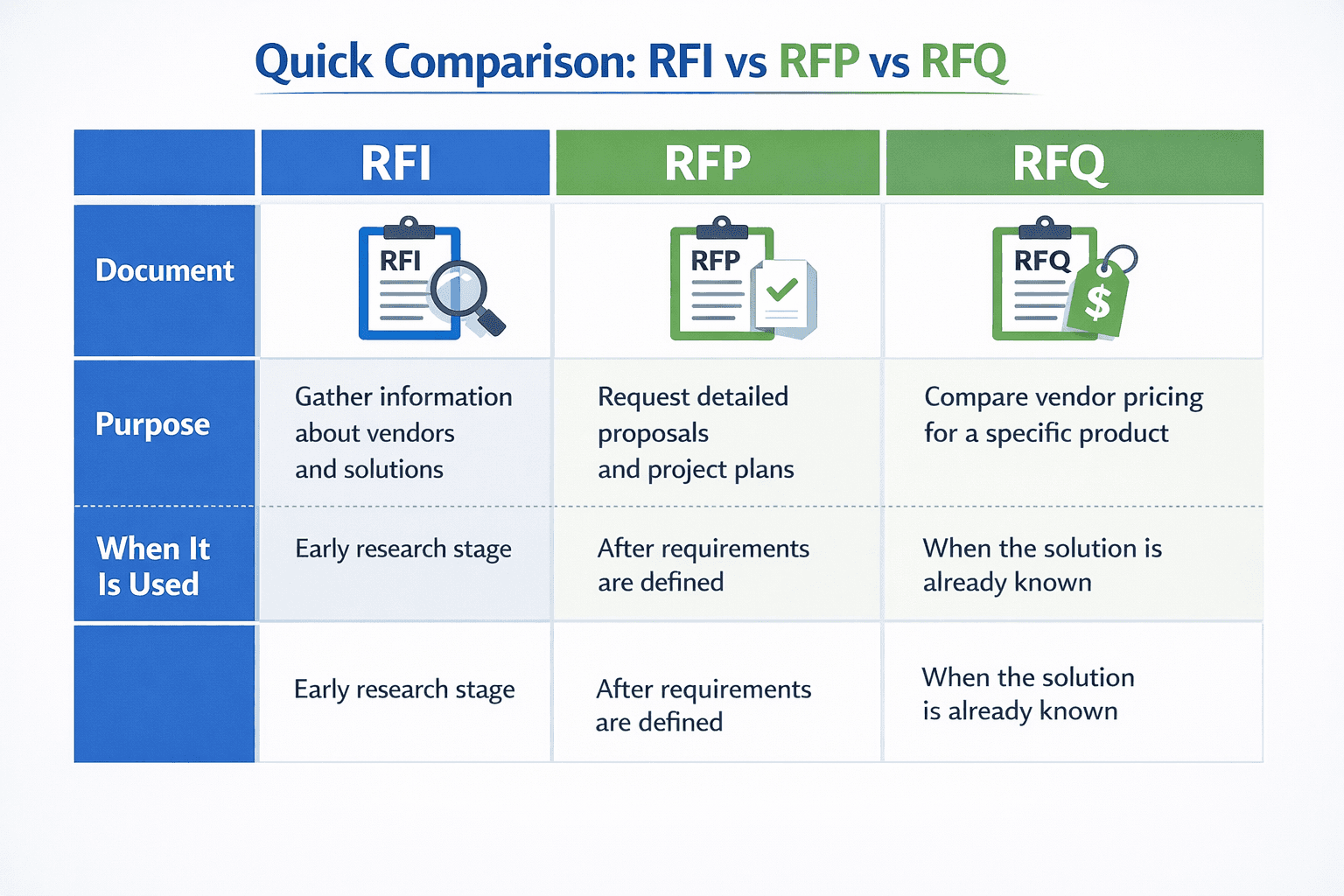
Most procurement processes follow this sequence:
RFI → RFP → RFQ
However, organizations sometimes skip steps if the project scope is already clear.
RFI Template Example
A well-structured RFI helps vendors provide clear and comparable responses. While the exact format varies by industry, most RFIs follow a similar structure.
Below is a simple template organizations can adapt.
1. Project Overview
Provide a summary of the problem you are trying to solve.
Example:
"Our organization is evaluating solutions that improve knowledge retrieval, compliance support, and operational efficiency across internal teams."
Include details such as:
business objectives
expected outcomes
timeline considerations
departments involved
2. Organization Background
Help vendors understand your operating environment.
Include information such as:
company size
number of users or employees
technology platforms currently in use
geographic regions or regulatory environments
Example for a mortgage lender:
loan volume per month
loan origination system (LOS)
number of underwriters and processors
states licensed
investor mix
3. Vendor Information
Ask vendors to provide background information about their company.
Example questions:
When was your company founded?
How many employees does your company have?
What industries do you primarily serve?
Can you provide three customer references?
4. Product and Technical Capabilities
This section evaluates how well the vendor’s solution fits your needs.
Example questions:
What integrations does your platform support?
Do you provide APIs for external systems?
How does your solution handle security and access control?
What analytics or reporting capabilities are included?
5. Security and Compliance
Many organizations include detailed questions about security and regulatory standards.
Example questions:
Do you maintain SOC2 Type II certification?
What encryption standards are used for data storage and transmission?
Do you provide audit logging for user actions?
What disaster recovery procedures are in place?
6. Implementation and Support
This section helps determine the operational impact of adopting the solution.
Example questions:
What is the typical implementation timeline?
What resources are required from our organization?
What onboarding and training support do you provide?
How is customer support structured?
7. Submission Instructions
Provide clear instructions for vendors responding to the RFI.
Include:
response format requirements
submission deadline
required attachments
contact information for clarification questions
Clear instructions help ensure responses are consistent and easier to evaluate.
Common RFI Mistakes to Avoid
Even well-intentioned RFIs can become difficult to manage if they are not structured carefully. Below are some of the most common mistakes organizations make when issuing RFIs.
Asking Questions That Are Too Broad
A common mistake is asking vague questions such as:
“Describe your platform capabilities.”
Questions like this encourage marketing-heavy responses that are difficult to compare across vendors.
Instead, ask specific and measurable questions such as:
Do you support SSO using Azure AD or Okta?
What is the average implementation timeline for a 500-user deployment?
Do you support audit logs by user action?
Focused questions produce clearer responses.
Allowing Vendors to Respond in Any Format
If vendors submit responses in completely different formats—PDFs, slides, spreadsheets—it becomes extremely difficult to compare answers.
To avoid this problem, require vendors to respond in a standardized template.
Standardized responses make evaluation faster and more objective.
Including Too Many Questions
Some RFIs contain hundreds of questions, which can overwhelm vendors and stakeholders alike.
The result is often rushed responses and long evaluation cycles.
A better approach is to focus on the most important decision criteria:
security and compliance
integrations
implementation risk
scalability
vendor credibility
Not Defining Evaluation Criteria
An RFI should clearly communicate how responses will be evaluated.
Without defined criteria, stakeholders may interpret answers differently, leading to inconsistent scoring and internal disagreements.
Evaluation criteria may include:
technical capability
compliance readiness
cost structure
implementation complexity
vendor experience
Managing the RFI Through Email
Another common mistake is managing RFI responses through scattered email threads.
Important information becomes fragmented across:
email attachments
shared drives
spreadsheets
meeting notes
Centralizing vendor responses in a single repository dramatically improves transparency and evaluation speed.
Treating the RFI as a One-Time Exercise
Many organizations reuse outdated RFI templates year after year.
But technology, regulations, and business priorities change quickly.
High-performing procurement teams review and update their RFI templates regularly to ensure they reflect current requirements and market expectations.
Want an RFI Template You Can Use Immediately?
AskBobAI can provide a customizable RFI template designed for:
financial services
mortgage lenders
SaaS companies
healthcare organizations
media publishers
government agencies
So you can collect cleaner responses, evaluate vendors faster, and make decisions with confidence.
Ready to prepare your next RFI faster and more effectively?
See how AskBobAI can help you research vendors, generate structured questions, and streamline the vendor evaluation process.
Photo Credit:Maks_Lab