Agentic AI vs Traditional AI: Understanding the Next Evolution of Artificial Intelligence
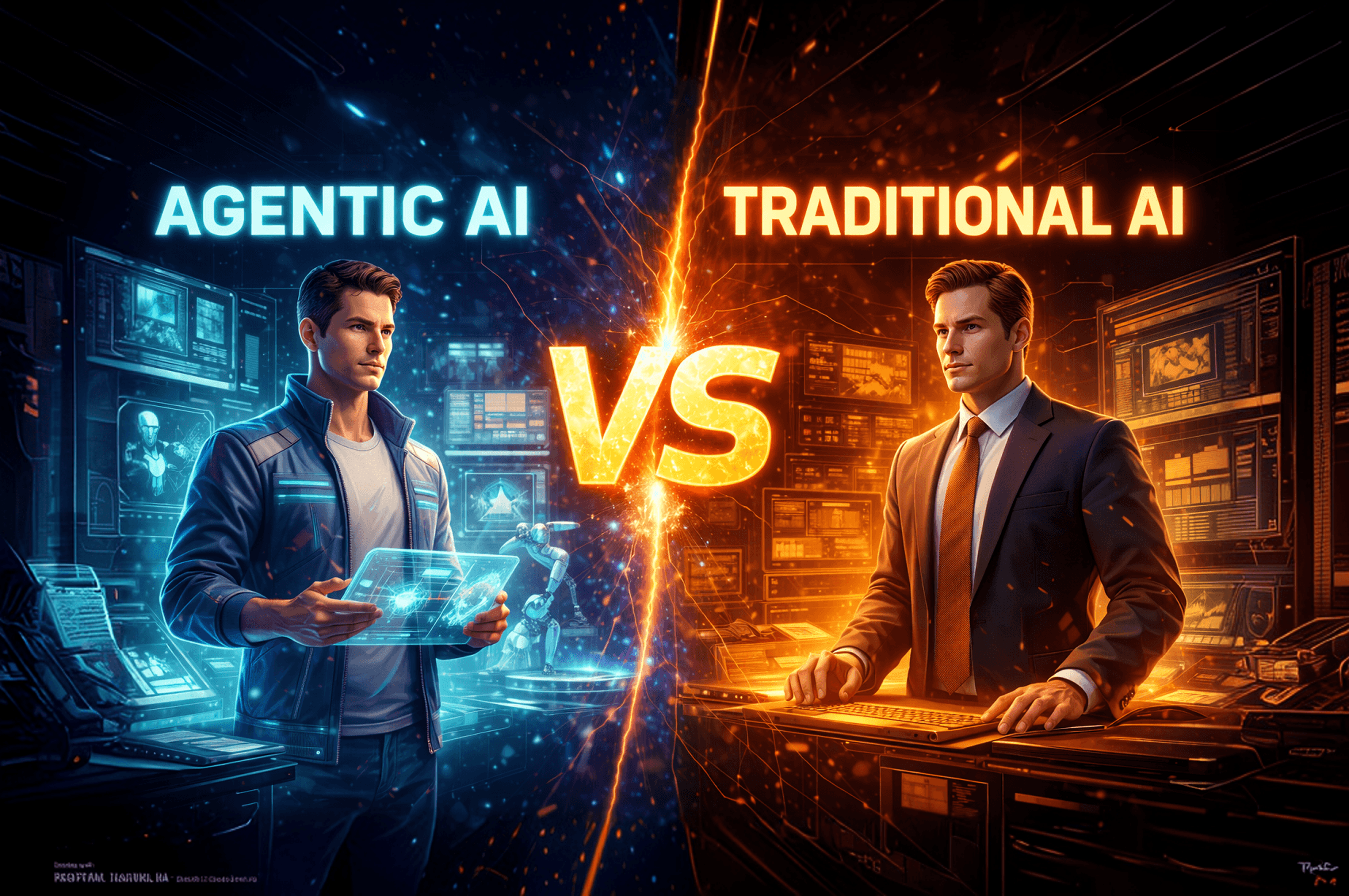
Artificial intelligence has evolved rapidly over the past decade. Early AI systems focused primarily on analyzing data and generating responses to user prompts. These traditional AI systems could classify images, answer questions, and predict outcomes based on patterns in data. While powerful, they generally relied on humans to guide each step of the process.
Today, a new phase of artificial intelligence is emerging known as Agentic AI. Agentic AI refers to autonomous AI systems designed to pursue goals, plan actions, interact with tools, and complete multi-step tasks with minimal human intervention.
Modern Agentic AI systems are capable of autonomous planning and reasoning, integrating with external tools and enterprise systems, managing long-running workflows, and collaborating with other AI agents. Instead of acting like a simple software tool that responds to individual requests, Agentic AI behaves more like a digital worker capable of coordinating tasks across systems and information sources.
This shift represents one of the most significant transformations in artificial intelligence since the rise of machine learning. As organizations increasingly deploy AI across their operations, understanding the difference between Agentic AI and traditional AI is becoming essential.
What Is Traditional AI?
Traditional AI refers to systems that analyze information and generate outputs based on user prompts or predefined rules. These systems typically operate in a reactive model, meaning they respond to requests but do not independently initiate actions.
Examples of traditional AI include:
Chatbots that answer questions
Image recognition systems
Predictive analytics models
Language translation tools
In these cases, the AI performs a single task based on a specific input. Once the task is completed, the process ends.
For example, if a user asks a chatbot a question, the system retrieves information, generates an answer, and returns the result. The AI does not continue working beyond that single request.
Traditional AI systems are powerful tools for automation and analysis, but they are generally limited to isolated tasks.
What Is Agentic AI?
Agentic AI refers to artificial intelligence systems designed to operate as autonomous agents capable of planning, reasoning, and executing multiple steps to accomplish a goal.
Instead of simply responding to prompts, agentic AI systems can:
Break down complex goals into smaller tasks
Determine what information is needed
Access tools or external systems
Evaluate intermediate results
Continue iterating until the objective is achieved
This behavior allows agentic AI systems to function more like digital workers rather than simple software tools.
For example, if a user asks an agentic AI system to prepare a market analysis report, the AI may:
Gather relevant industry data
Retrieve internal company metrics
Analyze trends
Generate visualizations
Write the final report
All of these steps may occur automatically without requiring the user to issue separate instructions.
Key Differences Between Agentic AI and Traditional AI
The primary difference between these two approaches lies in how the AI operates within a workflow.
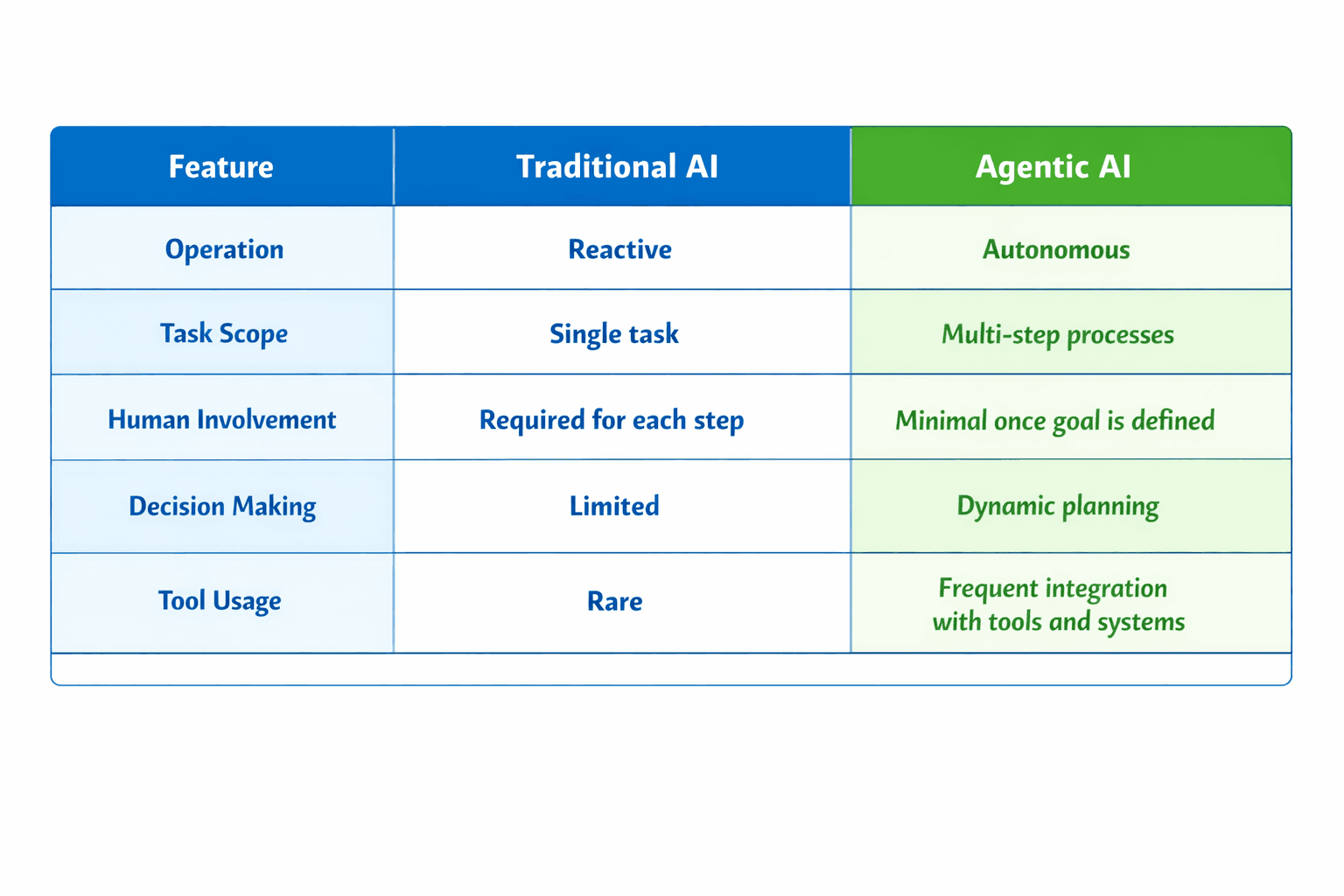
Traditional AI systems respond to prompts. Agentic AI systems pursue objectives.
This distinction fundamentally changes how artificial intelligence can be used inside organizations.
Real-World Business Applications
Agentic AI is expanding the types of problems AI can solve by handling complex workflows that previously required multiple employees or software systems.
Customer Support
Traditional AI chatbots answer individual questions.
Agentic AI systems can manage entire support cases by retrieving knowledge, analyzing account history, generating responses, and escalating issues when necessary.
Sales Operations
Traditional AI tools analyze sales data or recommend leads.
Agentic AI systems can research prospects, draft outreach messages, schedule follow-ups, update CRM records, and summarize pipeline activity automatically.
Financial Services
Predictive AI models forecast risk or market trends.
Agentic AI systems can evaluate loan applications, review documentation, compare policy guidelines, flag compliance risks, and prepare underwriting summaries.
Enterprise Knowledge Systems
Traditional AI search tools return documents.
Agentic AI systems can retrieve information across systems, synthesize knowledge, verify sources, and provide actionable guidance to employees.
Why Agentic AI Is Gaining Attention
The growing interest in agentic AI is largely driven by the increasing complexity of modern business operations.
Organizations operate across many systems, including:
document repositories
enterprise software platforms
data warehouses
communication tools
knowledge bases
Traditional AI tools help analyze individual pieces of this information, but they often require humans to connect the dots.
Agentic AI systems can operate across these environments and orchestrate multiple steps to solve problems more efficiently.
This shift moves AI from being a tool employees use to becoming a system that collaborates with employees.
The Role of Multi-Agent Systems
Many advanced agentic AI platforms rely on multi-agent architectures, where several specialized agents work together.
Each agent may focus on a specific domain, such as:
compliance
data analysis
documentation retrieval
task execution
decision support
These agents collaborate and share information to achieve broader goals.
For example, in a financial organization:
one agent may retrieve regulatory requirements
another may analyze financial data
another may generate a report
The combined system functions as a coordinated network of intelligent assistants.
Challenges of Agentic AI
While agentic AI introduces powerful capabilities, it also raises new challenges.
Reliability
Autonomous systems must ensure decisions are based on verified information. Guardrails and validation processes are essential.
Data Access
Agentic AI requires access to multiple systems, which introduces complexity in permissions and security management.
Oversight
Organizations must define clear rules regarding when AI can act independently and when human approval is required.
System Design
Building effective agentic architectures requires careful design to prevent errors, unnecessary loops, or inefficient workflows.
These challenges mean that successful agentic AI implementations depend not only on advanced models but also on strong system architecture and governance.
The Future of AI Systems
Artificial intelligence is gradually moving from isolated capabilities to integrated systems that operate across entire organizations.
Traditional AI will continue to play an important role in tasks such as prediction, classification, and data analysis.
However, agentic AI represents the next stage of evolution where AI systems can coordinate actions, interact with tools, and complete complex workflows.
As organizations adopt these systems, the role of AI will expand beyond answering questions to helping manage processes, generate insights, and accelerate decision-making.
Is Agentic AI the Future of Artificial Intelligence?
Agentic AI is widely viewed as the next stage in the evolution of artificial intelligence. While traditional AI models excel at analyzing data and generating responses, organizations increasingly require systems capable of coordinating actions across complex environments.
Businesses operate across multiple platforms including enterprise software, knowledge bases, communication tools, and data warehouses. Agentic AI systems can operate across these environments, orchestrating workflows that previously required multiple employees or disconnected tools.
Rather than replacing traditional AI, agentic architectures build on existing models by combining reasoning, planning, and tool usage.
This shift allows AI to move beyond answering questions and toward actively completing tasks and assisting employees in real-world workflows.
Q&A
What is Agentic AI?
Agentic AI refers to artificial intelligence systems designed to act as autonomous agents that can plan tasks, make decisions, use tools, and complete multi-step objectives with minimal human intervention.
What is traditional AI?
Traditional AI systems respond to prompts or inputs and perform a specific task such as answering a question, analyzing data, or recognizing patterns.
What is the main difference between Agentic AI and traditional AI?
Traditional AI is reactive and responds to individual requests, while Agentic AI is goal-oriented and can plan and execute multiple steps to achieve a defined objective.
How does Agentic AI work?
Agentic AI systems break down a goal into smaller tasks, gather the required information, use available tools or systems, and continue working until the objective is completed.
What are examples of traditional AI?
Examples include chatbots that answer questions, image recognition systems, predictive analytics models, and language translation tools.
What are examples of Agentic AI applications?
Examples include AI systems that manage customer support tickets, perform research tasks, automate sales outreach, or analyze financial data and generate reports.
Why are businesses interested in Agentic AI?
Businesses are interested in Agentic AI because it can automate complex workflows, reduce manual work, and help organizations complete tasks faster across multiple systems.
Does Agentic AI replace traditional AI?
No. Agentic AI builds on traditional AI models. Traditional AI still performs tasks like prediction and analysis, while Agentic AI orchestrates these capabilities to complete broader objectives.
Final Thoughts
The difference between traditional AI and agentic AI reflects a fundamental shift in how artificial intelligence is used.
Traditional AI focuses on analyzing information and generating responses. Agentic AI focuses on pursuing goals and executing multi-step tasks.
For businesses implementing AI, understanding this distinction is critical.
The future of artificial intelligence will not simply be about smarter models, but about systems capable of planning, acting, and collaborating with humans to solve real-world problems.